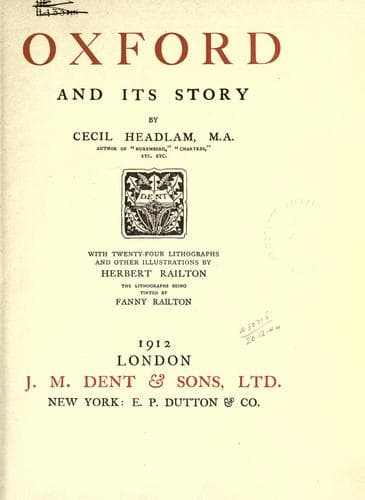
Oxford (England) -- History; University of Oxford -- History
News of the fray soon reached Henry III., who happened to be staying at
Abingdon, and he lost no time in despatching some soldiers to the
rescue. Under their powerful escort the Legate managed to ford the river
by night, accompanied by the members of his suite. Still as he galloped
away, he seemed to hear the shouts of his adversaries ringing in his
ears, "Where is that usurer, that simoniac, that spoiler of revenues,
and thirster after money, who perverts the King, overthrows the realm,
and enriches strangers with plunder taken from us?"
It was not long before the Papal Legate was forbidden the English
shores, and his bulls of excommunication were flung into the sea.
Simon de Montfort was the friend of Adam Marsh, and the confidant of
Grossetete, and it was appropriately enough at Oxford that the great
champion of English freedom secured the appointment of a council of
twenty-four to draw up terms for the reform of the State. Parliament
met at Oxford; the barons presented a long petition of grievances, the
council was elected, and a body of preliminary articles known as the
Provisions of Oxford was agreed upon. In the following year Henry
repudiated the Provisions; civil war ensued, and ended by placing the
country in the hands of Simon de Montfort.
The struggle between Henry and the barons then did not leave Oxford
unaffected. For any disturbance without was sure to be reflected in a
conflict between clerks and laymen, in a town and gown row, of some
magnitude. In the present case the appearance of Prince Edward with an
armed force--he took up his quarters at the King's Hall--in the northern
suburb gave occasion for an outbreak. The municipal authorities closed
the gates against him, and he resumed his march towards Wales.
The scholars now thought it was time that they should be allowed to go
out of the city, and finding themselves prevented by the closed wooden
doors of Smith Gate, they hewed these down and carried them away, like
Samson, into the fields, chanting over them the office of the dead:
"A Subvenite Sancti fast began to sing
As man doth when a dead man men will to pit bring."
The mayor retorted by throwing some of them into prison, in spite of the
Chancellor's protest. Further arrests were about to be made by the irate
townsmen, but a clerk saw them advancing in a body down the High Street,
and gave the alarm by ringing the bell of S. Mary's. The clerks were at
dinner, but hearing the well-known summons they sprang to arms and
rushed out into the street to give battle. Many of the foe were wounded;
the rest were put to flight. Their banners were torn to pieces, and
several shops were sacked by the victorious students, who, flushed with
victory, marched to the houses of the bailiffs and set them on fire.
"In the South half of the town, and afterwards the Spicery
They brake from end to other, and did all to robberie."
Public-domain text, read in full here on John Shaqi.
Reviews
Reviews
No reviews yet
Be the first to share your thoughts on this work.
Elsewhere in the archive
Join the Discussion
Join the discussion
Sign in to leave a comment or review.
Sign InorCreate an account