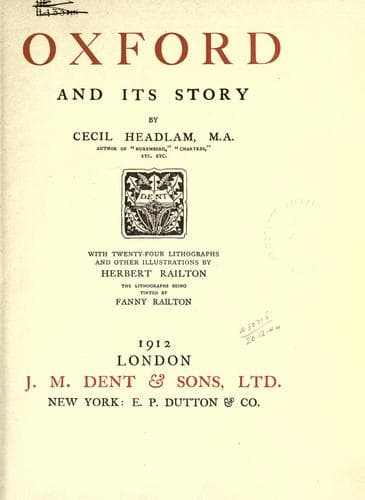
Oxford (England) -- History; University of Oxford -- History
Already enclosing walls had been built about the property, which was
bounded on the east by the Cherwell, on the south by the High Street,
on the west by what is now Long Wall Street, and on the north by the
lands of Holywell. The "Long Wall" bounded the "Grove," famous, since
the beginning of the eighteenth century, for its noble timber and herd
of deer. Most of the trees in the present grove are elms planted in the
seventeenth century, but there are two enormous wych elms, measured by
Oliver Wendell Holmes in 1886, which would have dwarfed that venerable
oak which stood near the entrance into the water-walk, and was blown
down "into the meadow" in 1789. It was over seven hundred years old
(girth 21 ft. 9 in., height 71 ft. 8 in.), and thought to be the same as
that named by the founder for a northern boundary.
In the arrangement of his buildings Waynflete followed Wykeham. Chapel,
hall and library were designed on the same plan. But the beautiful
"Founder's Tower," rendered now still more lovely by the drapery of
creepers which hangs about it, formed the principal entrance into
cloisters, which were part of the buildings of the main quadrangle,
carried an upper story of chambers, and were adorned with grotesques
symbolical of the Vices and Virtues. The entrance now used was
originally meant to serve only as the entrance from the cloister to the
chapel. It was adorned (_circa_ 1630) with a gateway similar to that
designed by Inigo Jones for the main entrance to the college.
The statutes were based on those of New College, but, in addition to
those of which we have already had occasion to speak, there were certain
notable improvements. The society was to consist of a President and
seventy scholars besides four chaplains, eight clerks and sixteen
choristers. Forty of these scholars were fellows forming one class, and
thirty were demies, forming another, whose tenure was limited and who
were given half the allowance of the fellows. They had no special claim
to promotion to fellowships. For their instruction a Grammar Master and
an usher were provided; when they were well skilled in Grammar, they
were to
[Illustration: The Founder's Tower Magdalen College]
be taught Logic and Sophistry by the college lecturers, whilst three
"Readers," in Natural and Moral Philosophy and Theology, chosen out of
the University, were to provide the higher teaching in Arts and
Theology. And all this teaching, in Theology and Philosophy and also in
Grammar, was to be given free to all comers at the expense of the
college.
Public-domain text, read in full here on John Shaqi.
Reviews
Reviews
No reviews yet
Be the first to share your thoughts on this work.
Elsewhere in the archive
Join the Discussion
Join the discussion
Sign in to leave a comment or review.
Sign InorCreate an account