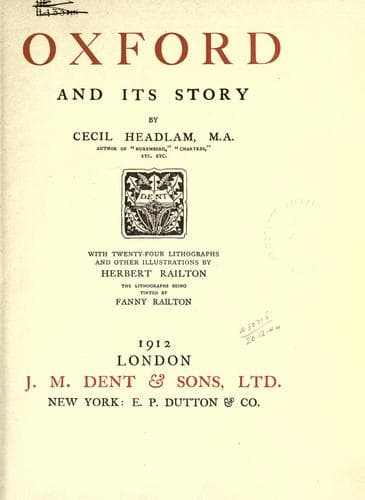
Oxford (England) -- History; University of Oxford -- History
In 1481 Waynflete, full of pride in his new foundation, "the most noble
and rich structure in the learned world," persuaded Edward IV. to come
over from Woodstock and see it. The King came at a few hours' notice.
But as the royal cavalcade drew near the North Gate of the town, a
little after sunset, it was met by the Chancellor and the masters of the
University and a great number of persons carrying lighted torches. The
King and his courtiers were hospitably received at Magdalen. On the
morrow the President delivered a congratulatory address, and the King
made a gracious reply; then he and his followers joined in a solemn
procession round the precincts and the cloisters of the college.
Two years later Richard III. was very similarly welcomed by the
University and entertained at Magdalen. On this occasion the King was
regaled with two disputations in the hall. Richard declared himself very
well pleased; and it is just possible that he was. For one of the
disputants was William Grocyn, who was rewarded with a buck and three
marks for his pains.
The University continued its policy of political time-serving, and,
after the battle of Bosworth Field, congratulated Henry VII. as
fulsomely as it had congratulated Richard III. a few months before.
Henry retorted by demanding the surrender of Robert Stillington, Bishop
of Bath and Wells, who was staying within the limits of the University.
This prelate was accused of "damnable conjuracies and conspiracies,"
which may have included complicity in the rebellion of Lambert Simnel.
For the future scullion was a native of Oxford. The University
prevaricated for a while; and at last, when hard pressed, they explained
that they would incur the sentence of excommunication if they used
force against a prelate of the Catholic Church. The King then took the
matter into his own hands, and committed the offender to prison at
Windsor for the remainder of his life. He soon afterwards visited
Oxford, offered a noble in the chapel of Magdalen College, and, by way
of marking his approval of the University, undertook the maintenance of
two students at Oxford. In 1493 he established at University College an
obit for the widow of Warwick the king-maker.
Public-domain text, read in full here on John Shaqi.
Reviews
Reviews
No reviews yet
Be the first to share your thoughts on this work.
Elsewhere in the archive
Join the Discussion
Join the discussion
Sign in to leave a comment or review.
Sign InorCreate an account