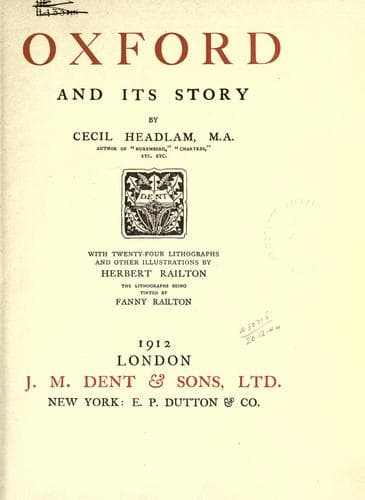
Oxford (England) -- History; University of Oxford -- History
The influence of other political classes was now also introduced. Never,
as Newman said, has a learned institution been more directly political
and national than the University of Oxford. Some of its colleges came to
represent the talent of the nation, others its rank and fashion, others
its wealth; others have been the organs of the Government of the day;
while others, and the majority, represented one or other division,
chiefly local, of opinion in the country. The local limitation of the
members of many colleges, the West Country character of Exeter, the
North Country character of Queen's or University, the South Country
character of New College, the Welsh character of Jesus College, for
instance, tended to accentuate this peculiarity. The whole nation was
thus brought into the University by means of the colleges, which
fortunately were sufficiently numerous, and no one of them
overwhelmingly important. A vigour and a stability were thus imparted to
the University such as the abundant influx of foreigners had not been
able to secure. As in the twelfth and thirteenth centuries, French,
German and Italian students had flocked to Oxford, and made its name
famous in distant lands; so in the fifteenth all ranks and classes of
the land furnished it with pupils, and what was wanting in their number
or variety, compared with the former era, was made up by their splendour
or political importance. The sons of the nobles came up to the
University, each accompanied by an ample retinue; the towns were kept in
touch with the University by means of the numerous members of it who
belonged to the clerical order. Town and country, high and low, north
and south, had a common stake in the academical institutions, and took a
personal interest in the academical proceedings. The degree possessed a
sort of indelible character which all classes understood; and the people
at large were more or less partakers of a cultivation which the
aristocracy were beginning to appreciate. Oxford, in fact, became the
centre of national and political thought. Not only in vacations and term
time was there a stated ebbing and flowing of the academical youth, but
messengers posted to and fro between Oxford and all parts of the country
in all seasons of the year. So intimate was this connection, that Oxford
became, as it were, the selected arena for the conflicts of the various
interests of the nation.
CHAPTER VI
OXFORD AND THE REFORMATION
Public-domain text, read in full here on John Shaqi.
Reviews
Reviews
No reviews yet
Be the first to share your thoughts on this work.
Elsewhere in the archive
Join the Discussion
Join the discussion
Sign in to leave a comment or review.
Sign InorCreate an account