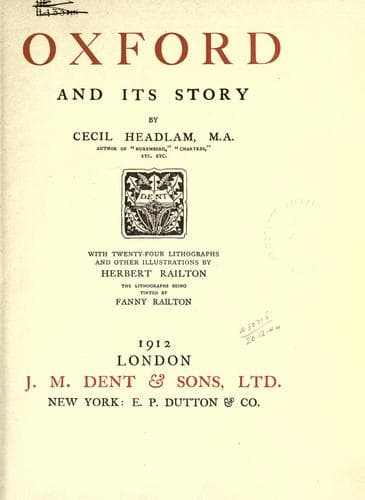
Oxford (England) -- History; University of Oxford -- History
Rood went into partnership with an Oxford stationer named Thomas Hunt,
and together they produced eight other books with a type more English in
character than the preceding ones. One of these books, "Phalaris," 1485
(Wadham and Corpus Libraries), has a curious colophon in verse, which
describes the printers and their ambition to surpass the Venetians in
their work. The partners ceased to produce books after 1486. Rood
probably returned to Cologne, and the German art found no exponents in
Oxford for the remainder of the century. Subsequently we find Leicester
advancing money to set up Joseph Barnes with a new press. Laud and Fell
were other great patrons of the University Press.
Meantime the return of the Pope to Rome had attracted many foreign
travellers and students to Italy, who could not fail to be impressed by
the new birth of art and intellectual life that was taking place in that
country.
Among the pupils of Guarino of Verona at Ferrara the names of at least
five students from Oxford occur. Of these, Robert Fleming, a relative of
the founder of Lincoln College, was an author of some distinction, and
he compiled a Græco-Latin dictionary at a time when Greek was almost
unknown in England. He brought back from his travels in Italy many
precious books, which he gave to the library of Lincoln College. William
Grey, another of Guarino's pupils, enriched the library of Balliol with
many fine manuscripts redolent of the New Learning. John Tiptoft, Earl
of Worcester, was another scholar who, before paying for his share in
politics with his head, presented to the University the valuable
collection of manuscripts, which he had made in the course of his
travels.
William Selling, a member of the recent foundation of All Souls', was
perhaps the earliest Englishman of influence to catch from Italy the
inspiration of the Greek muse. On his return from that country, he was
appointed to the conventual school at Canterbury. His knowledge of
Greek, and his enthusiasm for Greek literature, became the germ of the
study in England. Thomas Linacre was one of his pupils, who, after
studying at Oxford under Vitelli, journeyed to Italy with Selling. He
was introduced to Politian at Florence. Thence he proceeded to Rome, and
there perhaps formed his taste for the scientific writings of Aristotle
and his devotion to the study of medicine, which afterwards found
expression in the foundation of the College of Physicians and of the two
lectureships at Merton, now merged into the chair which bears his name.
Linacre returned to Oxford and lectured there awhile before being
appointed Physician to Henry VIII. His translation of five medical
treatises of Galen was, Erasmus declared, more valuable than the
original Greek.
Public-domain text, read in full here on John Shaqi.
Reviews
Reviews
No reviews yet
Be the first to share your thoughts on this work.
Elsewhere in the archive
Join the Discussion
Join the discussion
Sign in to leave a comment or review.
Sign InorCreate an account