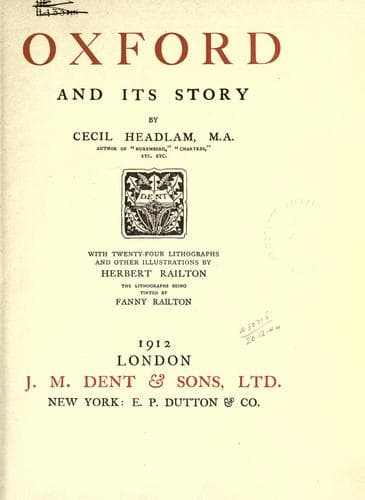
Oxford (England) -- History; University of Oxford -- History
Of Garret himself, however, no trace could be found; and the commissary,
being "in extreme pensyfness," consulted an astrologer, who made a
figure for him, and told him, with all the cheerful certainty of an
eastern astrologer in these days, that Garret, having fled
south-eastward in a tawny coat, was at that time in London, on his way
to the sea-side. Consulting the stars was strictly forbidden by the
Catholic Church, but the Warden of New College, though a Doctor of
Divinity, was not ashamed to inform the bishop of the astrologer's
saying, or afraid to ask him to inform the Cardinal, Archbishop of York,
concerning it. Luckily for him the commissary did not rely wholly on the
information either of Dalaber or the astrologer. The more practical
method of watching the seaport towns resulted a few days later in
Garret's recapture near Bristol. Many of the Oxford brotherhood were
also imprisoned and excommunicated. Garret, who had written a piteous
letter to Wolsey, praying for release, not from the iron bonds which he
said he justly deserved, but from the more terrible bonds of
excommunication, and who had also made a formal recantation of all his
heresies, was allowed to escape. But first he took part in a procession,
in which most of the other prisoners also appeared, carrying faggots
from S. Mary's Church to S. Frideswide's, and on the way casting into a
bonfire made at Carfax for the purpose certain books which had most
likely formed part of Garret's stock.
At least three of the prisoners, however, died in prison without having
been readmitted to Communion, either from the sweating sickness then
raging, or, as Foxe asserts, from the hardships they endured. For they
were kept, he says, for nearly six months in a deep cave under the
ground, on a diet of salt fish. By Higdon's orders they did at least
receive a Christian burial.
The heretics were crushed in Oxford, but elsewhere the movement grew
apace. The printing press scattered wide-cast books and pamphlets which
openly attacked the corruption of the Church and the monastic orders.
Henry determined to proscribe all books that savoured of heresy. A joint
committee of Oxford and Cambridge theologians was summoned to meet in
London. They examined and condemned the suspected books which were
submitted to them. The publication of English treatises upon Holy
Scripture without ecclesiastical sanction was forbidden by royal
proclamation. Versions of the Bible in the vulgar tongue were at the
same time proscribed.
Public-domain text, read in full here on John Shaqi.
Reviews
Reviews
No reviews yet
Be the first to share your thoughts on this work.
Elsewhere in the archive
Join the Discussion
Join the discussion
Sign in to leave a comment or review.
Sign InorCreate an account