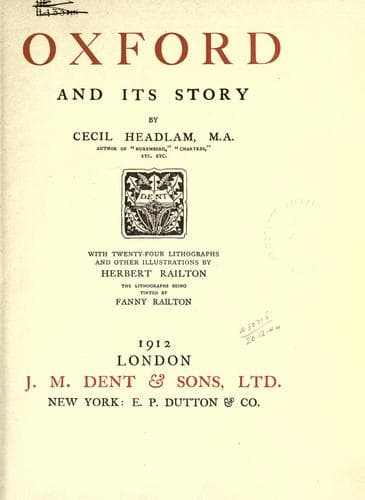
Oxford (England) -- History; University of Oxford -- History
Yet this orthodox king, to whom as "Defender of the Faith," Leo X. had
sent a sword still preserved in the Ashmolean, was on the brink of a
breach with Rome. For Henry, with his curious mania for matrimony, had
determined to marry Anne Boleyn, but he failed to obtain from the Papal
Legates in England a decree for the dissolution of his marriage. It was
a failure fraught with enormous consequences. The fortunes of Oxford
were involved in it. The King gladly availed himself of the suggestion
of a Cambridge scholar, Thomas Cranmer, that the Universities should be
called on for their judgment. They were thus placed in a position
analogous to that of an oecumenical council with power to control a
pontifical decree. For the Pope's predecessor had granted a
dispensation for Henry's marriage with Catherine, his brother's wife.
Every learned man in Europe, but for bribery or threats, would have
condemned Henry's cause on its merits. But it was evident that the
question would not be decided on its merits.
From a packed commission at Cambridge a decision favourable to a divorce
was with difficulty extorted; but even so it was qualified by an
important reservation. The marriage was declared illegal, if it could be
proved that Catherine's marriage with Prince Arthur had been
consummated. Cambridge was praised by the King for her "wisdom and good
conveyance." Yet that reservation, if the testimony of the Queen herself
was to go for anything, amounted to a conclusion against the divorce.
It was not expected that a favourable verdict would be obtained so
easily from Oxford. At the end of his first letter, in which the King
called upon the University to declare their minds "sincerely and truly
without any abuse," a very plain threat is added, which left no doubt as
to the royal view of what could be considered "sincere and true":
"And in case ye do not uprightly according to divine learning
handle yourselves herein, ye may be assured that we, not without
great cause, shall so quickly and sharply look to your unnatural
misdemeanour therein that it shall not be to your quietness and
ease hereafter."
It was proposed that the question should be referred to a packed
committee. But the Masters of Arts refused to entrust the matter wholly
to the Faculty of Theology. They claimed to nominate a certain number of
delegates. Their attitude provoked sharp reproval and further threats
from the imperious monarch.
The youths of the University were warned not to play masters, or they
would soon learn that "it is not good to stir up a hornets' nest."
Public-domain text, read in full here on John Shaqi.
Reviews
Reviews
No reviews yet
Be the first to share your thoughts on this work.
Elsewhere in the archive
Join the Discussion
Join the discussion
Sign in to leave a comment or review.
Sign InorCreate an account