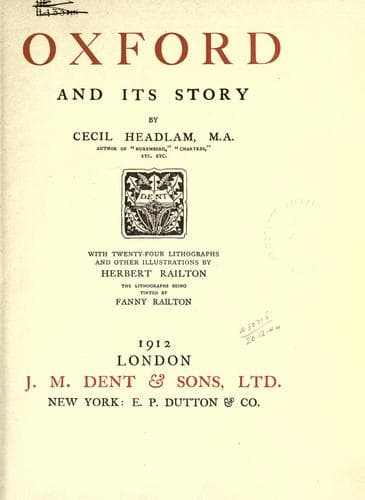
Oxford (England) -- History; University of Oxford -- History
"Now are you lord no longer!" cried Bonnor when the ceremony was
finished. "All this needed not," the Archbishop replied; "I myself had
done with this gear long ago."
Cranmer had been three years in prison; he was an old man, and his nerve
may well have been upset by the prolonged delay and fear of death and
the recent degradation which he had undergone. There is no authentic
account of what happened to him during the next few hours. But
Protestant tradition relates that he was taken from the Cathedral to the
Deanery of Christ Church, where he was entertained at his ease and
exposed to the arguments and exhortations of Soto, the Spanish friar. He
was warned at the same time that the Queen's mind was so set, that she
would either have Cranmer a Catholic or else no Cranmer at all. He was
taken back to his cell that night, and there his constancy at last gave
way. He signed a series of recantations. But the Queen refused to
relent; she had humiliated her enemy, and now he must die. She fixed the
25th of March for the day of his execution. But first he was called
upon to make a public confession of his recantation. It was a foul and
rainy day when he was brought out of Bocardo to S. Mary's Church. Peers,
knights, doctors, students, priests, men-at-arms and citizens thronged
the narrow aisles, and through their midst passed the mayor and next the
aldermen in their place and degree; after them came Cranmer between two
Spanish friars, who, on entering the church, chanted the _Nunc
Dimittis_. A stage was set over against the pulpit--the ledge cut for it
may still be seen in the pillar to the left of the Vice-Chancellor's
chair--and here Cranmer was made to stand in his bare and ragged gown,
and old square cap, whilst Dr Cole, the Warden of New College, preached
his funeral sermon, and justified the sentence that had been passed, by
which, even though he had recanted, he was condemned to die.
Cole gave this reason and that, and added that there were others which
had moved the Queen and Council "which were not meet and convenient for
every one to understand." He congratulated the Archbishop on his
conversion, and promised him that a dirge should be sung for him in
every church in Oxford. Finally, he called upon the whole congregation
to kneel where they were and to pray for him. When the prayer was
finished the preacher called upon the Archbishop to make the public
confession of his faith. "Brethren," cried he, "lest any man should
doubt of this man's earnest conversion and repentance, you shall hear
him speak before you." But the spirit of revenge had overreached itself.
Cranmer's enemies had hoped to humiliate him to the uttermost; instead,
they gave him the opportunity of redeeming his fame and adding his name
to the roll of martyrs.
"The tongues of dying men
Enforce attention, like deep harmony....
More are men's ends marked than their lives before."
Public-domain text, read in full here on John Shaqi.
Reviews
Reviews
No reviews yet
Be the first to share your thoughts on this work.
Elsewhere in the archive
Join the Discussion
Join the discussion
Sign in to leave a comment or review.
Sign InorCreate an account