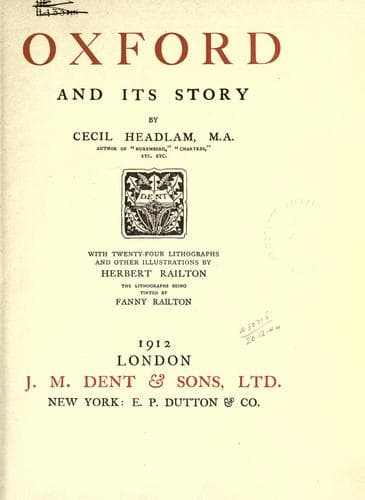
Oxford (England) -- History; University of Oxford -- History
To the astonishment of friends and foes alike, Cranmer stood up before
the congregation, and chanted the palinode of his forsworn opinions; he
recanted his recantation. Face to face with that cruel
[Illustration: The President's Lodge Trinity College]
death, which in his weakness he had so desperately striven to avoid, he
made the declaration of his true belief. "And now I come," he concluded,
"to the great thing which so much troubleth my conscience, more
than anything that ever I did or said in my whole life, and that is
the setting abroad of a writing contrary to the truth; which now
here I renounce and refuse as things written with my hand, contrary
to the truth which I thought in my heart, and written for fear of
death, and to save my life if it might be;... And forasmuch as my
hand offended, writing contrary to my heart, my hand shall first be
punished therefore; for, may I come to the fire, it shall be first
burned. As for the Pope I utterly refuse him, as Christ's enemy and
Anti-Christ, with all his false doctrine; and as for the Sacrament,
I believe as I have taught in my book against the Bishop of
Winchester."
So far he was allowed to proceed before, amidst the infuriated cries of
his enemies, he was pulled down from the stage and borne away to the
stake. "Priests who did rue to see him go so wickedly to his death, ran
after him exhorting him, while time was, to remember himself." But
Cranmer had remembered himself at last. He had done with recantations at
the bidding of Spanish priests and "bloody" Bonnor. He approached the
stake with a cheerful countenance, we are told, undressed in haste and
stood upright in his shirt. The Spanish friars finding they could do
nothing with him, exclaimed the one to the other, "Let us go from him,
for the devil is in him." "Make short," cried Lord Williams, and
"Recant, recant," cried others. The wood was kindled. "This was the hand
that wrote it," Cranmer said, extending his right arm, "therefore it
shall suffer first punishment." He held his hand so steadfast and
immovable in the flame that all men might see it burned before his body
was touched. And so holding it he never stirred nor cried till the fire
reached him and he was dead.
A portrait of Cranmer hangs in the Bodleian. But the chief monument to
the Protestant martyrs was raised in 1841. The Martyrs' Memorial in S.
Giles', opposite the west front of Balliol College, was happily designed
by Sir Gilbert Scott in imitation of the beautiful crosses which Edward
I. raised in memory of Queen Eleanor. The statues of the martyrs are by
Weekes. The north aisle of the neighbouring Church of S. Mary Magdalene
was restored at the same time in memory of the same event.
Public-domain text, read in full here on John Shaqi.
Reviews
Reviews
No reviews yet
Be the first to share your thoughts on this work.
Elsewhere in the archive
Join the Discussion
Join the discussion
Sign in to leave a comment or review.
Sign InorCreate an account