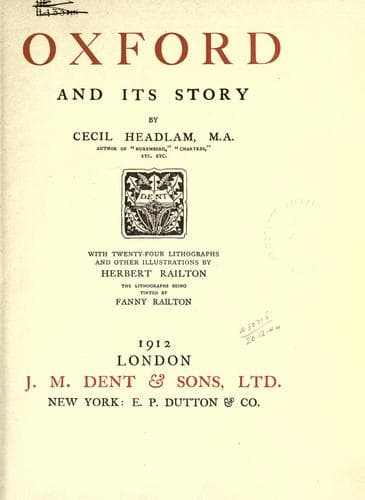
Oxford (England) -- History; University of Oxford -- History
So to approach it, and passing by the outer library through the yielding
wicket, into Duke Humphrey's gallery, there to turn into one of the
quiet recesses, and calling for book after book, to summon spirits from
the deep of the past, to hold quiet converse with them, while the breeze
and sunlight flow gently in across Wren's huge buttresses from the green
garden of Exeter, till Bodley's own solemn bell calls them back to their
resting-place; this, as has been well said, is the very luxury, or
rather the very poetry of study. "What a place," exclaimed Elia, "What a
place to be in is an old library! It seems as though all the souls of
all the writers, that have bequeathed their labours to these Bodleians,
were reposing here, as in some dormitory, or middle state. I do not want
to handle, to profane the leaves, their winding-sheets. I could as soon
dislodge a shade. I seem to inhale learning, walking amid their foliage;
and the odour of their old moth-scented coverings is fragrant as the
first bloom of those sciential apples which grew amid the happy
orchard."
The growth of the Puritan feeling in Oxford is shown by the formation of
the first Baptist society under Vavasour Powell of Jesus College, whom
John Bunyan once accompanied to this city. The growth of the Puritan
tendency to preach is also indicated by the strange case of Richard
Haydock, a physician of New College, who obtained some notoriety about
this time by preaching at night in his bed. Sermons, he said, came to
him by revelation in his sleep, and he would take a text in his slumbers
and preach on it, "and though his auditory were willing to silence him
by pulling, haling and pinching, yet would he pertinaciously persist to
the end and sleep still." He was not a married fellow evidently. King
James sent for him, and he preached to the monarch in his sleep, but
James made him confess that he was a fraud, who had adopted this curious
means of advertising himself.
The King and Queen and Prince Henry visited Oxford in 1605, and were
welcomed very much as Elizabeth had been. The King, we are told, showed
himself to be of an admirable wit and judgment. The scholars welcomed
him by clapping their hands and humming, which, it was explained to him,
signified applause.
The presence of King James' court, however, was responsible, if we may
believe Wood, for a serious change in manners. For he traces the rise of
that "damnable sin of drunkenness" to this time.
"For wheras in the days of Elizabeth it was little or nothing
practiced, sack being then taken rather for a cordial than a usual
liquor, sold also for that purpose in apothecaries' shops, and a
heinous crime it was to be overtaken with drink, or smoke tobacco,
it now became in a manner common, and a laudable fashion."
Public-domain text, read in full here on John Shaqi.
Reviews
Reviews
No reviews yet
Be the first to share your thoughts on this work.
Elsewhere in the archive
Join the Discussion
Join the discussion
Sign in to leave a comment or review.
Sign InorCreate an account