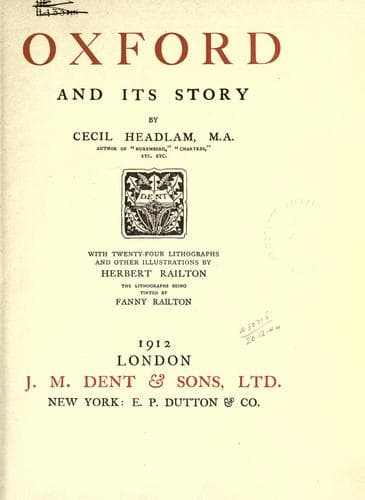
Oxford (England) -- History; University of Oxford -- History
The vice in fact grew so prevalent in Oxford, as in the rest of England,
that a statute was passed forbidding members of the University to visit
any tavern and there "sit idly, drink, or use any unlawful play." The
use of the Latin tongue, attendance at lectures and the wearing of
academical dress was also insisted on by the new Chancellor, Archbishop
Bancroft, who added an injunction that long hair was not to be worn:
long hair in those days being accounted a sign not of a poet but of a
swaggerer and ruffian. A few years later it was provided, as a measure
directed against the still increasing vice of drunkenness, that no
scholar should lodge without his college or hall, and that no citizen
should entertain a scholar in his house.
The Gunpowder Plot led to more stringent measures being taken to root
out the Roman Catholics from the University. It is possibly to the deep
impression made by that event that the foundation of Wadham College is
due. The founder of that college (1609), Nicholas Wadham, is said to
have intended to endow a Roman Catholic college at Venice, but to have
decided to endow a number of non-clerical and terminable fellowships at
Oxford instead. His widow, Dorothy, carried out his plans, and, after
Gloucester Hall had refused the benefaction, purchased the site of the
suppressed settlement of Augustinian Friars and built the front
quadrangle with hall and chapel as, externally, we have them to-day. For
the interior of the chapel was dealt with by the Gothic revivalists
(1834). The Wadhams were West Country folk, and the majority of workmen
engaged were Somersetshire men. It is suggested that the extraordinarily
fine Perpendicular character of the chapel choir is due to this fact;
and that the masons reproduced, in the seventeenth century, the style of
their county churches. The choir is a copy of fifteenth-century work;
the ante-chapel and the rest of the quadrangle, so charming in its
unadorned simplicity, are beautiful examples of the survival in Oxford
of the Gothic tradition. Quadrangles at Merton and Wadham are the most
notable examples of this debased and nondescript style, redeemed by most
excellent composition, proportioned like some Elizabethan manor.
James had been inclined at first to favour the Puritans, but when he
finally cast in his lot with the High Church party, the University,
which he, like Elizabeth, had done his best to conciliate as the
educational centre of the national clergy, supported him loyally. In the
year of his accession he had granted letters patent to both
Universities, empowering them each to choose two grave and learned men,
professing the civil law, to serve as burgesses in the House of
Parliament; and the Universities were again indebted to him when they
were called upon to furnish scholars for the great task of preparing the
Authorised Version of the Bible.
Public-domain text, read in full here on John Shaqi.
Reviews
Reviews
No reviews yet
Be the first to share your thoughts on this work.
Elsewhere in the archive
Join the Discussion
Join the discussion
Sign in to leave a comment or review.
Sign InorCreate an account