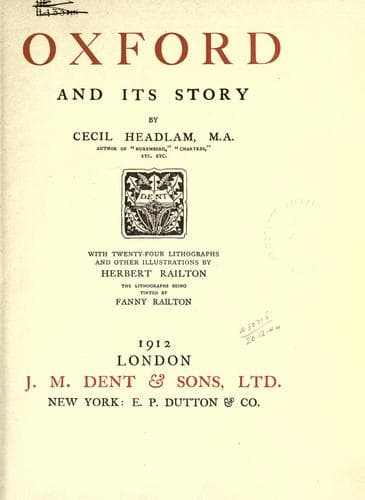
Oxford (England) -- History; University of Oxford -- History
Meantime certain improvements were taking place in the city. Under the
Commissioners Act (1771) the streets were widened and paved, and most of
the walls and gates removed--Bocardo along with them. Turnpike Roads and
the Enclosures Acts led to the disappearance of the highwaymen, by whom
coaches, ere railways took the place of the "flying coach," which first
went to London in one day "with A. W. in the same coach" (1669), had so
frequently been held up near Oxford. Curiously enough highwaymen were
most popular with the fair sex, and the cowardly ruffians occasionally
returned the compliment so far as to allow them to ransom their jewels
with a kiss. Dumas, the prince of highwaymen, after capturing a coachful
of ladies, was satisfied with dancing a coranto with each in turn upon
the green. He was executed at Oxford. He had maintained his nonchalance
to the end; played "Macheath" in the prison, and threw himself off at
the gallows without troubling the hangman. It was not death, he
declared, but being anatomised that he feared. And, lest their hero
should be put to so useful a purpose, a large body of bargemen
surrounded the scaffold, carried off the body in triumph to the parish
church and buried it in lime forthwith.
At length, after the Age of Reason and Materialism, came the Age of
Revival and Romance. The spirit of mediævalism summoned up by Sir
Walter, was typified in Oxford architecture by Sir Gilbert Scott and
Pugin. In the University the beginning of a new order of things, which
was to end in throwing open the Universities to the whole Empire and
rendering them on every side efficient places of education, was begun in
1800 by the system of Honours Lists, long advocated by reformers like
John Eveleigh of Oriel and brought into being by the energy of Cyril
Jackson, Dean of Christ Church, and Parsons, Master of Balliol. The work
of nationalising the Universities was developed by the two University
Commissions and by that "Extension" movement, of which the pioneer was
William Sewell, a remarkable tutor of Exeter, who, in 1850, urged that
"It may be impossible to bring the masses to the University, but may it
not be possible to carry the University to the masses?" This development
of the University, which must ever be closely connected with the name of
Dr Jowett, Master of Balliol, and has received a further significance
from the last testament of Cecil Rhodes, of Oriel, is illustrated on
every side by new buildings; by the Indian Institute, the Nonconformist
colleges, Mansfield and Manchester, the Women's Halls, the Science
Buildings and the new foundation of Hertford College, grafted on that of
old Hart Hall and Magdalen Hall by Mr Baring. Intellectually the spirit
of revolt produced by the French Revolution at the beginning of this
period, is illustrated by the careers of Shelley and Landor, and the
musical lyrics of Swinburne; the deep questionings prompted by the
Tractarian Movement are voiced in the poems of Clough, Keble and Arnold.
Public-domain text, read in full here on John Shaqi.
Reviews
Reviews
No reviews yet
Be the first to share your thoughts on this work.
Elsewhere in the archive
Join the Discussion
Join the discussion
Sign in to leave a comment or review.
Sign InorCreate an account