Even the ancient rule of electing churchwardens, by single votes, has
been set aside in Paddington; the Judges of the Exchequor Court
sanctioning this proceeding, when the vestry appealed to that Court, by
writ of error, from the decision of the learned Lord Chief Justice
Denman, who had confirmed to the inhabitants of this place, their ancient
right in this particular: {199} a right, which every inhabitant, who was
not a lawyer, must have believed, as that learned Judge did, the tenth
clause of the local Act confirmed to him. This clause declares that the
election of vestrymen shall not take place, until after the usual
election of churchwardens; “which election of churchwardens shall take
place on _Easter Tuesday_, and be conducted from year to year in such
manner, as hath been usual in the same parish.”
The rule of plural voting for vestrymen having been established by the
adoption of Sturges Bourne’s Act, vestrymen so elected could not sanction
the election of church-wardens in the manner which had been usual in the
parish; viz.—by show of hands. Those gentlemen, who still govern
Paddington, determined to take advantage of a legal quibble, to abrogate
the ancient form of election; but their proceedings produced an amount of
ill-feeling, which lasted for years, between those who now really had the
election of parish officers in their hands, and those who, in consequence
of the introduction of this new principle, had nothing to do with
parochial affairs, except the payment of whatever sums of money were
demanded. This feeling is indeed not yet allayed; neither can it be till
this act of injustice to the majority, is for ever and entirely revoked.
And justice must not long be delayed, if harmony is to be restored.
Upwards of 2,000 rate-payers have this year voted in favour of that Act,
which gives a single vote, and but one vote in local elections; and it
behoves all who pay towards the local expenses, all who are interested in
the welfare of this parish, to think of this, and to co-operate by every
means in their power, for the establishment of good government on the
solid basis of just principles. When this is done, all discord may
cease; for it will then be the fault of the majority if Paddington is
badly governed.
* * * * *
THE END.
* * * * *
* * * * *
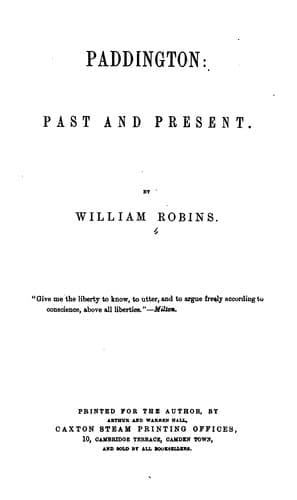
A. & W. HALL, Caxton Steam Printing Office, 10, Cambridge Terrace, Camden
Town.
FOOTNOTES
{1a} Cunningham’s Hand Book of London, 1850, p. 369. The Marylebone
Borough Almanack, 1853.
{1b} Environs of London, vol. iii. p. 329. This error is repeated in
Lewis’s Topographical Dictionary and seems to have been copied by all
subsequent authors. And although Lysons is generally accurate, we shall
find this is not the only error he has made respecting this manor.
{1c} Archæologia, vol. 26, p. 231.
Public-domain text, read in full here on John Shaqi.
Reviews
Reviews
No reviews yet
Be the first to share your thoughts on this work.
Elsewhere in the archive
Join the Discussion
Join the discussion
Sign in to leave a comment or review.
Sign InorCreate an account