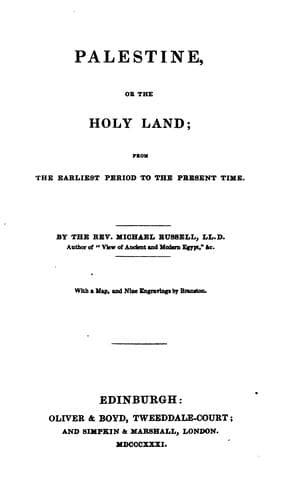
Palestine, or, the Holy Land: From the Earliest Period to the Present TimeRussell, Michael
History
Palestine, or, the Holy Land: From the Earliest Period to the Present Time
Russell, Michael
Palestine -- Description and travel; Palestine -- History
Produced by Distributed Proofreaders
[Illustration: Map of Palestine]
PALESTINE
OR
THE HOLY LAND.
From the Earliest Period to the Present Time.
BY THE REV. MICHAEL RUSSELL, LL.D.
PREFACE.
In giving an account of the Holy Land, an author, upon examining his
materials, finds himself presented with the choice either of simple
history on the one hand, or of mere local description on the other; and
the character of his book is of course determined by, the selection which
he makes of the first or the second of these departments. The volumes on
Palestine hitherto laid before the public will accordingly be found to
contain either a bare abridgment of the annals of the Jewish people, or a
topographical delineation of the country, the cities, and the towns which
they inhabited, from the date of the conquest under Joshua, down to the
period of their dispersion by Titus and Adrian. Several able works have
recently appeared on each of these subjects, and have been, almost without
exception, rewarded with the popularity which is seldom refused to
learning, and eloquence. But it occurred to the writer of the following
pages, that the expectations of the general reader would be more fully
answered were the two plans to be united, and the constitution, the
antiquities, the religion, the literature, and even the statistics of,
the Hebrews combined with the narrative of their rise and fall in the
sacred land bestowed upon their fathers.
In following out this scheme, he has made it his study to leave no
source of information unexplored which might supply the means of
illustrating the political condition of the Twelve Tribes immediately
after they settled on the banks of the Jordan. The principles which
entered into the constitution of their commonwealth are extremely
interesting, both as they afford a fine example of the progress of
society in one of its earliest stages, when the migratory shepherd
gradually assumes the habits of the agriculturalist; and also as they
confirm the results of experience, in other cases, in regard to the
change which usually follows in the form of civil government, and in
the concentration of power in the hands of an individual.
Public-domain text, read in full here on John Shaqi.
Reviews
Reviews
No reviews yet
Be the first to share your thoughts on this work.
Join the Discussion
Join the discussion
Sign in to leave a comment or review.
Sign InorCreate an account