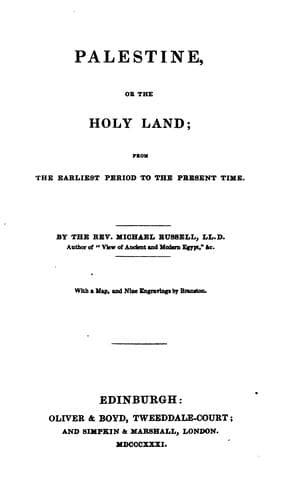
Palestine, or, the Holy Land: From the Earliest Period to the Present TimeRussell, Michael
History
Palestine, or, the Holy Land: From the Earliest Period to the Present Time
Russell, Michael
Palestine -- Description and travel; Palestine -- History
There are frequent remains of towers, dungeons, and even of
castles with ramparts and ditches, in some of which are a few Barbary
soldiers with nothing but a shirt and a musket. These ruins, however, are
more commonly inhabited by owls, jackals, and scorpions.[71]
The only remarkable antiquity at Ramla is the minaret of a decayed mosque,
which, by an Arabic inscription, appears to have been built by the Sultan
of Egypt. From the summit, which is very lofty, the eye follows the whole
chain of mountains, beginning at Nablous, and skirting the extremity of
the plain till it loses itself in the south.
A ride of two hours brings the traveller to the verge of the mountains,
where the road opens through a rugged ravine, and is formed in the dry
channel of a torrent. A scene of marked solitude and desolation surrounds
his steps as he pursues his journey in what is so simply described in the
gospel as the "hill country of Judea." He finds himself amid a labyrinth
of mountains, of a conical figure, all nearly alike, and connected with
each other at their base. A naked rock presents strata or beds resembling
the seats of a Roman amphitheatre, or the walls which support the
vineyards in the valleys of Savoy. Every recess is filled with dwarf oaks,
box, and rose-laurels. From the bottom of the ravines olive-trees rear
their heads, sometimes forming continuous woods on the sides of the hills.
On reaching the most elevated summit of this chain, he looks down towards
the south-west on the beautiful valley of Sharon, bounded by the Great
Sea; before him opens the Vale of St. Jeremiah; and in the same direction,
on the top of a rock, appears in the distance an ancient fortress called
the Castle of the Maccabees. It is conjectured that the author of the
Lamentations came into the world in the village which has retained his
name amid these mountains; so much is certain, at least, that the
melancholy of this desolate scene appears to pervade the compositions of
the prophet of sorrows.
The unvarying manners of the East exhibit to the view of the stranger, at
the present day, the same picture of rural innocence and simplicity which
might have met the eye of the mother of the Redeemer when she came into
this pastoral country to salute her cousin Elizabeth. Herds of goats, with
pendent ears, sheep with large tails, and asses which remind you, by their
beauty, of the onagra of Scripture, issue from the villages at the dawn of
day. Arab women are seen bringing grapes to dry in the vineyards; others
with their faces veiled, carrying pitchers of water on their heads, like
the daughters of Midian.
Public-domain text, read in full here on John Shaqi.
Reviews
Reviews
No reviews yet
Be the first to share your thoughts on this work.
Elsewhere in the archive
Join the Discussion
Join the discussion
Sign in to leave a comment or review.
Sign InorCreate an account