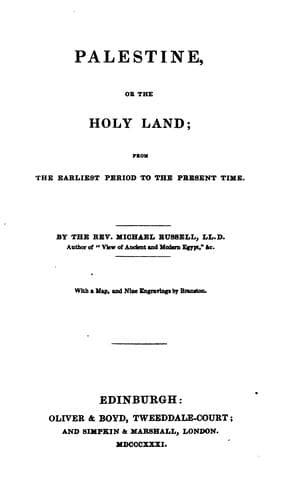
Palestine, or, the Holy Land: From the Earliest Period to the Present TimeRussell, Michael
History
Palestine, or, the Holy Land: From the Earliest Period to the Present Time
Russell, Michael
Palestine -- Description and travel; Palestine -- History
The path by which the billy barrier is penetrated is difficult, and in
some places dangerous. But before you reach it, turning towards the east,
you perceive Rama, or Ramla, the ancient Arimathea, distinguished by its
charming situation, and well known as the residence of a Christian
community. The convent, it is true, had been plundered five years before
it was visited by Chateaubriand; and it was not without the most urgent
solicitation that the friars were permitted to repair their building, as
if it were a maxim among the Turks, who by their domination continue to
afflict and disgrace the finest parts of Palestine, that the progress of
ruin and decay should never be arrested. Volney tells us, that when he was
at Ramla a commander resided there in a serai, the walls and floors of
which were on the point of tumbling down. He asked one of the inferior
officers why his master did not at least pay some attention to his own
apartment. The reply was, "If another shall obtain his place next year,
who will repay the expense?"
In those days the aga maintained about one hundred horsemen and as many
African soldiers, who were lodged in an old Christian church, the nave of
which was converted into a stable, as also in an ancient khan, which was
disputed with them by the scorpions. The adjacent country is planted with
lofty olives, the greatest part of which are as large as the walnut-trees
of France, though they are daily perishing through age and the ravages of
contending factions. When a peasant is disposed to take revenge on his
enemy, he goes by night and outs his trees close to the ground, when the
wound, which he carefully covers from the sight, drains off the sap like
an issue. Amid these plantations are seen at every step dry wells,
cisterns fallen in, and immense vaulted reservoirs, which prove that in
ancient times this town must have been upwards of four miles in
circumference. At present it does not contain more than a hundred
miserable families. The houses are only so many huts, sometimes detached,
and sometimes ranged in the form of cells round a court, enclosed by a mud
wall. In winter, the inhabitants and their cattle may be said to live
together; the part of the building allotted to themselves being raised
only two feet above that in which they lodge their beasts. The peasants
are by this means kept warm without burning wood,--a species of economy
indispensable in a country absolutely destitute of fuel. As to the fire
necessary for culinary purposes, they make it, as was the practice in the
days of Ezekiel the prophet, of dung kneaded into cakes, which they dry in
the sun, exposing them to its rays on the walls of their huts. In summer,
their lodging is more airy; but all their furniture consists of a single
mat and a pitcher for carrying water. The immediate neighborhood of the
village is sown at the proper season with grain and watermelons; all the
rest is a desert, and abandoned to the Bedouin Arabs, who feed their
flocks on it.
Public-domain text, read in full here on John Shaqi.
Reviews
Reviews
No reviews yet
Be the first to share your thoughts on this work.
Elsewhere in the archive
Join the Discussion
Join the discussion
Sign in to leave a comment or review.
Sign InorCreate an account