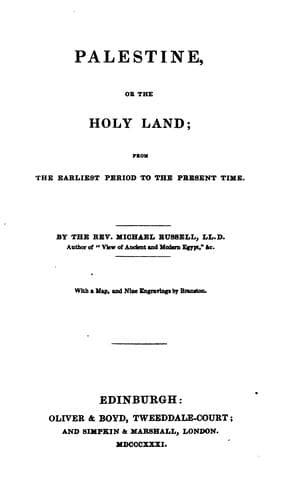
Palestine, or, the Holy Land: From the Earliest Period to the Present TimeRussell, Michael
History
Palestine, or, the Holy Land: From the Earliest Period to the Present Time
Russell, Michael
Palestine -- Description and travel; Palestine -- History
The main error of the modern priests at Jerusalem arises from an anxiety
to exhibit every thing to which any allusion is made by the evangelical
historians; not remembering that the lapse of ages and the devastation of
successive wars have destroyed much, and disguised more, which the early
disciples could most readily identify. The mere circumstance that almost
all the events which attended the close of our Saviour's ministry are
crowded into one scene, covered by the roof of a single church, might
excite a very justifiable doubt as to the exactness of the topography
maintained by the friars of Mount Moriah. "This edifice," says Mr.
Maundrell, "is less than one hundred paces long, and not more than sixty
wide; and yet it is so contrived, that it is supposed to contain under its
roof twelve or thirteen sanctuaries, or places consecrated to a more than
ordinary veneration, by being reputed to have some particular actions done
in them relating to the death and resurrection of Christ."[89]
All that can now be affirmed, observes Dr. Clarke, with any show of
reason, is this, "that if Helena had reason to believe she could identify
the spot where the Sepulchre was, she took especial care to remove every
trace of it, in order to introduce the fanciful and modern work which now
remains. The place may be the same pointed out to her; but not a remnant
of the original Sepulchre can now be ascertained. Yet, with our skeptical
feelings thus awakened, it may prove how powerful the effect of sympathy
is, if we confess, that when we entered into the supposed Sepulchre, and
beheld, by the light of lamps there continually burning, the venerable
figure of an aged monk, with streaming eyes and a long white beard,
pointing to 'the place where the Lord lay,' and calling upon us to kneel
and experience pardon for our sins,--we did kneel, and we participated in
the feelings of more credulous pilgrims. Captain Culverhouse, in whose
mind the ideas of religion and of patriotism were inseparable, with firmer
emotion, drew from its scabbard the sword he had so often wielded in the
defence of his country, and placed it upon the tomb. Humbler comers heaped
the memorials of an accomplished pilgrimage; and while their sighs alone
interrupted the silence of the sanctuary a solemn service was begun."[90]
Public-domain text, read in full here on John Shaqi.
Reviews
Reviews
No reviews yet
Be the first to share your thoughts on this work.
Elsewhere in the archive
Join the Discussion
Join the discussion
Sign in to leave a comment or review.
Sign InorCreate an account