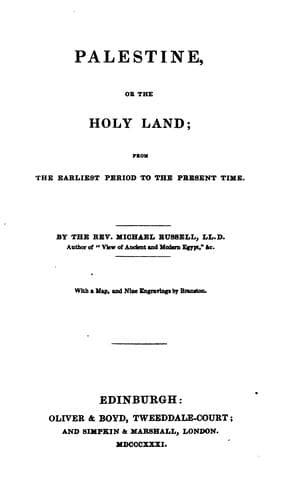
Palestine, or, the Holy Land: From the Earliest Period to the Present TimeRussell, Michael
History
Palestine, or, the Holy Land: From the Earliest Period to the Present Time
Russell, Michael
Palestine -- Description and travel; Palestine -- History
The Valley of Jehoshaphat stretches between the eastern walls of the city
and the Mount of Olives, containing a great variety of objects, to which
allusion is made in the Sacred Writings. It was sometimes called the
King's Dale, from a reference to an event recorded in the history of
Abraham, and was afterward distinguished by the name of Jehoshaphat,
because that sovereign erected in it a magnificent tomb. This narrow vale
seems to have always served as a burying-place for the inhabitants of the
holy city: there you meet with monuments of the most remote ages, as well
as of the most modern times: thither the descendants of Jacob resort from
the four quarters of the globe, to yield up their last breath; and a
foreigner sells to them, for its weight in gold, a scanty spot of earth to
cover their remains in the land of their forefathers. Observing many Jews,
whom I could easily recognise by their yellow turbans, quick dark eyes,
black eyebrows, and bushy beards, walking about the place, and reposing
along the Brook Kedron in a pensive mood, the pathetic language of the
Psalmist occurred to me, as expressing the subject of their
meditation--'By the rivers we sat down and wept when we remembered Zion.'
Upon frequently inquiring the motive that prompted them in attempting to
go to Jerusalem, the answer was, 'To die in the land of our fathers.'[95]
This valley or dale still exhibits a very desolate appearance. The western
side is a high chalk-cliff supporting the walls of the city; above which
you perceive Jerusalem itself; while the eastern acclivity is formed by
the Mount of Olives and the Mount of Offence, so called from the idolatry
which oppresses the fame of Solomon. These two hills are nearly naked, and
of a dull red colour. On their slopes are seen, here and there, a few
bleak and parched vines, some groves of wild olive-trees, wastes covered
with hyssop, chapels, oratories, and mosques in ruins. At the bottom of
the valley you discover a bridge of a single arch, thrown across the
channel of the Brook Kedron. The stones in the Jewish cemetery look like a
heap of rubbish at the foot of the Mount of Offence, below the Arab
village of Siloane, the paltry houses of which are scarcely to be
distinguished from the surrounding sepulchres. From the stillness of
Jerusalem, whence no smoke arises and no noise proceeds,--from the
solitude of these hills, where no living creature is to be seen,--from the
ruinous state of all these tombs, overthrown, broken, and half-open, you
would imagine that the last trumpet had already sounded, and that the
Valley of Jehoshaphat was about to render up its dead.
Public-domain text, read in full here on John Shaqi.
Reviews
Reviews
No reviews yet
Be the first to share your thoughts on this work.
Elsewhere in the archive
Join the Discussion
Join the discussion
Sign in to leave a comment or review.
Sign InorCreate an account