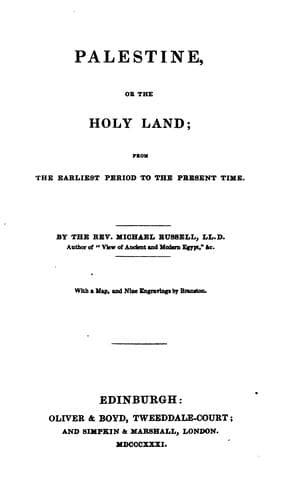
Palestine, or, the Holy Land: From the Earliest Period to the Present TimeRussell, Michael
History
Palestine, or, the Holy Land: From the Earliest Period to the Present Time
Russell, Michael
Palestine -- Description and travel; Palestine -- History
Amid this scene of desolation three monuments arrest the eyes of the
intelligent pilgrim,--the tombs of Zachariah, of Absalom, and of the king
whose name still distinguishes the valley. The first-mentioned of these is
a square mass of rock, hewn down into form, and isolated from the quarry
out of which it is cut by a passage of twelve or fifteen feet wide on
three of its sides; the fourth or western front being open towards the
valley and to Mount Moriah, the foot of which is only a few yards distant.
This huge stone is eight paces in length on each side, and about twenty
feet high in the front, and ten feet high at the back; the hill on which
it stands having a steep ascent. It has four semicolumns cut out of the
same rock on each of its faces, with a pilaster at each angle, all of a
mixed Ionic order, and ornamented in bad taste. The architraves, the full
moulding, and the deep overhanging cornice which finishes the square, are
all perfectly after the Egyptian manner; and the whole is surmounted by a
pyramid, the sloping aides of which rise from the very edges of the square
below, and terminate in a finished point.
The body of this monument, we have already stated, is one solid mass of
rock, as well as its semicolumns on each face; but the surmounting pyramid
appears to be of masonry. Its sides, however, are perfectly smooth, like
the coated pyramids of Sahara and Dashour, and not graduated by stages
like those of Dijzeh in lower Egypt.
Inconsiderable in size and paltry in its ornaments, this monument, as Mr.
Buckingham observes, is eminently curious. There is no appearance of an
entrance into any part of it; so that it seems; if a tomb, to have been as
firmly closed as the Egyptian pyramids, and, perhaps, for the same respect
for the repose of the dead. It is probable, indeed, that the original
style and plan of the building are derived from the country of the
Pharaohs; while the Grecian columns and pilasters may be the work of a
much later period, when the Jews had learned to combine with the massy
piles of their more ancient architecture the elegant lightness which
distinguished the times of the Seleucidae.[96]
In the immediate vicinity is the tomb of Jehoshaphat,--a cavern which is
more commonly called the Grotto of the Disciples, from an idea that they
went frequently thither to be taught by their Divine Master. The front of
this excavation has two Doric pillars of small size, but of just
proportions. In the interior are three chambers, all of them rude and
irregular in their form, in one of which were several gravestones,
removed, we may suppose, from the open ground for greater security. Like
all the rest, they were flat slabs of an oblong shape, from three to six
inches in thickness, and evidently a portion of the limestone rock which
composes the adjoining hills.
Public-domain text, read in full here on John Shaqi.
Reviews
Reviews
No reviews yet
Be the first to share your thoughts on this work.
Elsewhere in the archive
Join the Discussion
Join the discussion
Sign in to leave a comment or review.
Sign InorCreate an account