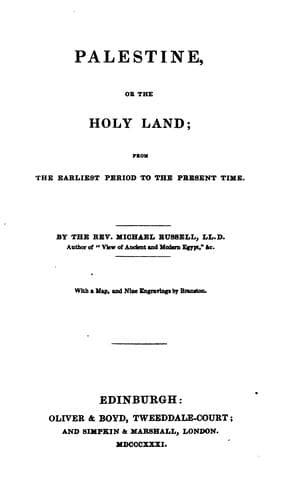
Palestine, or, the Holy Land: From the Earliest Period to the Present TimeRussell, Michael
History
Palestine, or, the Holy Land: From the Earliest Period to the Present Time
Russell, Michael
Palestine -- Description and travel; Palestine -- History
But it is nevertheless worthy of remark, that from the very situation of
Jerusalem, so well defined by natural limits which it cannot have passed,
there is less difficulty in determining places with a certain degree of
precision than would be experienced in any other ancient town. Nor can it
be justly questioned, that the primitive Christians marked with peculiar
care the principal localities distinguished by the deeds or by the
afflictions of their Divine Master. It is natural to suppose, as M.
Chateaubriand well observes, that the apostles and relatives of our
Saviour, who composed his first church upon earth, were perfectly
acquainted with all the circumstances attending his life, his ministry,
and his death; and as Golgotha and the Mount of Olives were not enclosed
within the walls of the city, they would encounter less restraint in
performing their devotions to the places which were sanctified by his more
frequent presence and miracles. Besides, the knowledge of these scenes was
soon extended to a very wide circle. The triumph of Pentecost increased
vastly the number of believers; and hence a regular congregation appears
to have been formed in Jerusalem before the expiry of the third year from
that memorable epoch. If it be admitted that the early Christians were
allowed to erect monuments to their religious worship, or even to select
houses for their periodical assemblies, the probability will not be
questioned that they fixed upon those interesting spots which had been
distinguished by the wonders of their faith.
At the commencement of the troubles in Judea, during the reign of
Vespasian, the Christians of Jerusalem withdrew to Pella, and as soon as
their metropolis was demolished they returned to dwell among its ruins.
In the space of a few months they could not have forgotten the position
of their sanctuaries, which, generally speaking, being situated outside
the walls, could not have suffered so much from the siege as the more
lofty edifices within. That the holy places were known to all men in the
time of Adrian is demonstrated by an undeniable fact. This emperor, when
he rebuilt the city, erected a statue of Venus on Mount Calvary, and
another of Jupiter on the sacred sepulchre. The grotto of Bethlehem was
given up to the rites of Adonis, the jealousy of the idolaters thus
publishing by their abominable profanations, the sublime doctrines of
the Cross, which it was their object to conceal or calumniate.
Public-domain text, read in full here on John Shaqi.
Reviews
Reviews
No reviews yet
Be the first to share your thoughts on this work.
Join the Discussion
Join the discussion
Sign in to leave a comment or review.
Sign InorCreate an account