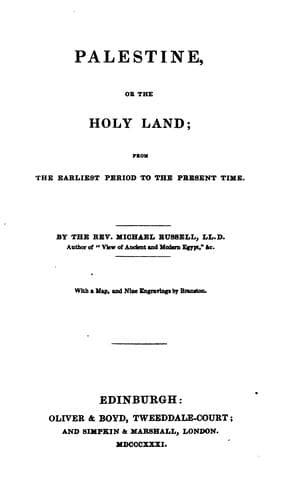
Palestine, or, the Holy Land: From the Earliest Period to the Present TimeRussell, Michael
History
Palestine, or, the Holy Land: From the Earliest Period to the Present Time
Russell, Michael
Palestine -- Description and travel; Palestine -- History
"We passed by the place of St. Stephen's martyrdom down into the Valley of
Jehoshaphat. This valley, independently of associations, is highly
picturesque. It is deep and narrow; the lower part is green with scattered
olives. The slope up towards the city is also smooth and green, and
crowned by the towers and battlements. On ascending the Mount of Olives,
which we did towards the south, we had a splendid view of Jerusalem. The
chief ornaments are the two domes of the Holy Sepulchre, the mosque of
Omar, and another large mosque with a smaller dome; but the white houses
make a good show, and the walls are picturesque. On looking at Jerusalem
from this place, the great features seemed to me to agree entirely with
the established maps, and Dr. Clarke's theory appeared quite untenable.
The only difficulty is, that there is no valley which _runs up all the
way_ so as to divide entirely Mount Zion from Mount Moriah. A ravine does
run far enough to cut off the Temple, but no more. The extent of this
difficulty must depend on the description left us of the Tyropaeum and
Millo. Was there a deep valley such as time and change might not have
obliterated? The people of the convent gave the name of the Mount of
Offence to a low hill on the south of the Mount of Olives; but Clarke
seems to think that the real Mount of Offence is that divided by Jehinnom
from Zion, and called by our guide Monte de Mal Consiglio. We visited the
Mohammedan chapel over the place of the Ascension, and saw the alleged
print of Christ's foot. We next went to the place called Viri Galilaei (ye
men of Galilee), and, after looking in vain for Dr. Clarke's pagan
remains, descended towards the Cave of the Prophets. We saw the well where
Nehemiah found the fire of the altar, and then went up the Valley of
Hinnom; first to the tomb called the Crypt of the Apostles, close to the
Aceldama, or Field of Blood. We saw many other grottoes; one had [Greek:
taes hagias Sion] inscribed upon it, as had another much farther up. Near
this last was that which Clarke maintained to be the Holy Sepulchre. We
saw one which would do very well for it; but so would many others. This
one was a cave, with a place for a body cut out in the back part of it,
but raised like a stone trough, not sunk in the floor. There is, of
course, not a shadow of reason for thinking Clarke's cave to be the real
one, and very little that I can see for doubting that the nominal Holy
Sepulchre is so in fact, or, rather, that it is _on the site_ of the real
one, which must have been destroyed when Adrian erected his temple to
Venus on the spot. From these caves we went by the Pool of Bathsheba to
the Bethlehem Gate, and so along the west side of the town to the Tombs of
the Judges and Kings, which lie north or north-west of the city. I
observed large foundations of ancient walls and heaps of rubbish west of
the modern town, where Clarke seems to assume that there was anciently no
part of the city.
Public-domain text, read in full here on John Shaqi.
Reviews
Reviews
No reviews yet
Be the first to share your thoughts on this work.
Elsewhere in the archive
Join the Discussion
Join the discussion
Sign in to leave a comment or review.
Sign InorCreate an account