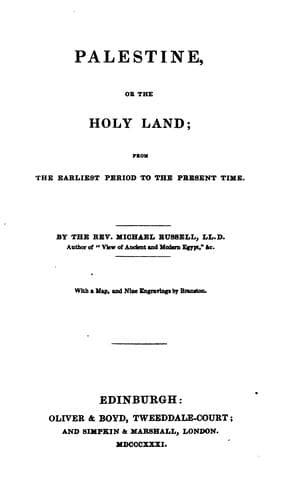
Palestine, or, the Holy Land: From the Earliest Period to the Present TimeRussell, Michael
History
Palestine, or, the Holy Land: From the Earliest Period to the Present Time
Russell, Michael
Palestine -- Description and travel; Palestine -- History
There and on the north I also observed wells opening
into large covered reservoirs for water. We entered only one of the Tombs
of the Judges, the rest being insignificant. That one was large, with a
pediment which had dentiles and other Greek ornaments. Inside there were
at least three chambers, surrounded by receptacles for bodies. In
returning we went to the Tombs of the Kings, which, like the others, are
cut out of the rock, and, like them too, have Grecian ornaments. There is
one large cave; the front has a handsome entablature, the upper part
ornamented with alternate circular garlands, bunches of grapes, and an
ornament of acanthus leaves; the lower with a rich band of foliage
disposed with much elegance."[98]
Hence, it appears that the weight of evidence preponderates decidedly in
favour of the common opinions in regard to the form of the ancient city
and the places which are usually denominated holy. Why, then, should any
one attempt to disturb the belief or acquiescence of the Christian world
on a subject concerning which all nations have hitherto found reason to
agree? The members of the primitive church had better means than we have
of being fully informed respecting the scenes of the evangelical history;
and it is manifest that amid all the changes which ensued in Jerusalem,
either from conquest or superstition, nothing was more unlikely than that
the faithful should forget the sacred spot where their redemption was
completed, or that they should consent to transfer their veneration to any
other.[99]
CHAPTER VI.
_Description of the Country South and East of Jerusalem_.
Garden of Gethsemane; Tomb of Virgin Mary; Grottoes on Mount of Olives;
View of the City; Extent and Boundaries; View of Bethany and Dead Sea;
Bethlehem; Convent; Church of the Nativity described; Paintings; Music;
Population of Bethlehem; Pools of Solomon; Dwelling of Simon the Leper; Of
Mary Magdalene; Tower of Simeon; Tomb of Rachel; Convent of John; Fine
Church; Tekoa; Bethulia; Hebron; Sepulchre of Patriarchs; Albaid; Kerek;
Extremity of Dead Sea; Discoveries of Bankes, Legh, and Irby and Mangles;
Convent of St. Saba; Valley of Jordan; Mountains; Description of Lake
Asphaltites; Remains of Ancient Cities in its Basin; Quality of its
Waters; Apples of Sodom; Tacitus, Seetzen, Hasselquist, Chateaubriand;
Width of River Jordan; Jericho-Village of Rihhah; Balsam; Fountain of
Elisha; Mount of Temptation; Place of Blood; Anecdote of Sir F. Henniker;
Fountain of the Apostles; Return to Jerusalem; Markets; Costume; Science;
Arts; Language; Jews; Present Condition of that People.
Public-domain text, read in full here on John Shaqi.
Reviews
Reviews
No reviews yet
Be the first to share your thoughts on this work.
Elsewhere in the archive
Join the Discussion
Join the discussion
Sign in to leave a comment or review.
Sign InorCreate an account