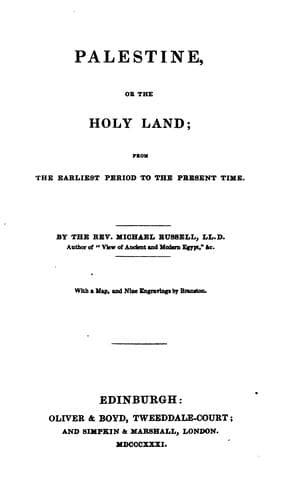
Palestine, or, the Holy Land: From the Earliest Period to the Present TimeRussell, Michael
History
Palestine, or, the Holy Land: From the Earliest Period to the Present Time
Russell, Michael
Palestine -- Description and travel; Palestine -- History
In a valley contiguous to Bethlehem are the remains of a church and
convent which were erected by the pious empress over the place where the
angels appeared to the shepherds. Nothing has survived the desolation to
which every edifice in Palestine has been repeatedly subjected but a small
grotto wherein the heavenly communication was vouchsafed to the simple
keepers of the flock.
On the way back to Jerusalem the traveller is induced to leave the more
direct route, that he may visit the Convent of St. John in the Desert.
This monastery is built over the dwelling where the Baptist is supposed to
have first seen the light; and accordingly, under the altar, the spot on
which he was brought forth is marked by a star of marble bearing this
inscription:--
"Hic precursor Domini Christi natus est."
Here the forerunner of the Lord Christ was born.
The church belonging to this establishment has been described as one of
the best in the Holy Land, having an elegant cupola and a pavement of
Mosaic, with some paintings. But the appearance, nevertheless, is poor and
deserted, as if its votaries were few, and but little concerned in
preserving its ancient grandeur. The account given of it by Sandys will
amuse the reader by the simplicity of the narrative as well as by the deep
interest the good man felt in the various scenes which passed before
him:--"Having travelled about a mile and a halfe farther, we came to the
cave where the baptist is said to have lived from the age of seven until
such time as he went into the wilderness by Jordan, sequestered from the
abode of man, and feeding on such wilde nourishment as these uninhabited
places afforded. This cave is seated on the northern side of a desert
mountaine,--only beholden to the locust-tree,--hewne out of the
precipitating rock, so as difficultly to be ascended or descended to,
entered at the east corner, and receiving light from a window in the side.
At the upper end there is a bench of the selfesame, whereon, they say, he
accustomed to sleeps; of which whoso breaks a piece off stands forthwith
excommunicate. Over this, on a little flat stand the ruins of a monastery,
on the south aide, naturally walled with the steepe of a mountain; from
whence there gusheth a living spring which entereth the rock, and again
bursteth forth beneathe the mouth of the cave,--a place that would make
solitarinesse delightful, and stand in comparison with the turbulent pompe
of cities. This overlooketh a profound valley, on the far side hemmed with
aspiring mountains, whereof some are cut (or naturally so) in degrees like
allies, which would be else unaccessibly fruitlesse; whose levels yet bear
the stumps of decayed vines, shadowed not rarely with olives and locusts.
And surely I think that all or most of those mountains have bin so
husbanded, else could this little country have never sustained such a
multitude of people. After we had fed of such provision as was brought us
Public-domain text, read in full here on John Shaqi.
Reviews
Reviews
No reviews yet
Be the first to share your thoughts on this work.
Elsewhere in the archive
Join the Discussion
Join the discussion
Sign in to leave a comment or review.
Sign InorCreate an account