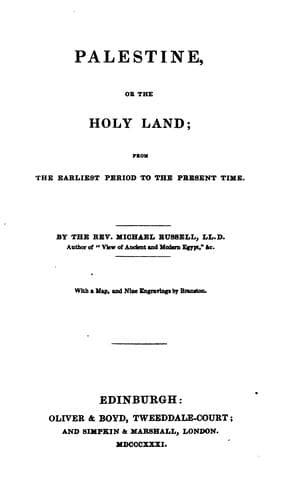
Palestine, or, the Holy Land: From the Earliest Period to the Present TimeRussell, Michael
History
Palestine, or, the Holy Land: From the Earliest Period to the Present Time
Russell, Michael
Palestine -- Description and travel; Palestine -- History
from the city by other of the fraternitie that there met us, we turned
towards Jerusalem, leaving the way of Bethlehem on the right-hand, and
that of Emmaus on the left. The first place of note that we met with was
there where once stood the dwelling of Zachary, seated on the side of a
fruitful hill, well stored with olives and vineyards. Hither came the
blessed Virgin to visit her cousin Elisabeth. Here died Elisabeth, and
here, in a grot, on the aide of a vault or chapell, lies buried; over
which a goodly church war erected, together with a monastery, whereof now
little standeth but a part of the walls, which offer to the view some
fragments of painting, which show that the rest have been exquisit. Beyond
and lower is Our Lady's Fountaine (so called of the inhabitants), which
maintaineth a little current thorow the neighbouring valley. Near this, in
the bottome and uttermost extent thereof, there standeth a temple, once
sumptuous, now desolate, built by Helena, and dedicated to St. John
Baptist, in the place where Zachary had another house, possest, as the
rest, by the beastly Arabians, who defile it with their cattell, and
employ to the basest of uses."[106]
It is a point still unsettled, whether the food of him who was sent to
prepare the way consisted of fruit or of insects; the name locust being
indiscriminately applied to either, and both being used by the inhabitants
of Palestine. There is less doubt in regard to the opinions of the early
Christians, who were unanimous in the belief that the Baptist lived on the
produce of a particular tree which still abounds in the desert. Nay, the
friars at the present day assert, that the very plants which yielded
sustenance to the holy recluse continue to flourish in their ancient
vigour; and the popish pilgrims, says Mr. Maundrell, who dare not be wiser
than such blind guides, gather the fruit of them, and carry it away with
much devotion.
But we must not permit the interesting associations of Bethlehem to detain
us any longer in its vicinity. We proceed now towards the extremity of the
Dead Sea; whence, after having visited the most remarkable scenes on its
western shore,--the mouth of the Jordan and the position of Jericho,--we
shall return to the capital by a different route.
Public-domain text, read in full here on John Shaqi.
Reviews
Reviews
No reviews yet
Be the first to share your thoughts on this work.
Elsewhere in the archive
Join the Discussion
Join the discussion
Sign in to leave a comment or review.
Sign InorCreate an account