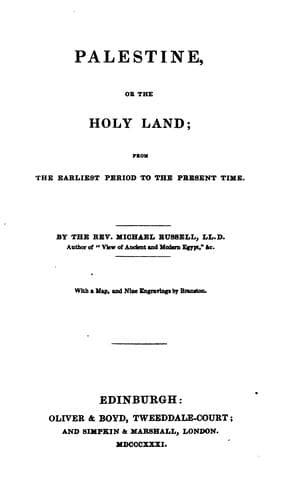
Palestine, or, the Holy Land: From the Earliest Period to the Present TimeRussell, Michael
History
Palestine, or, the Holy Land: From the Earliest Period to the Present Time
Russell, Michael
Palestine -- Description and travel; Palestine -- History
covered with rich carpets of green silk, magnificently embroidered with
gold; those of their wives are red, embroidered in like manner. The
sultans of Constantinople furnish these carpets, which are renewed from
time to time. M. Burckhardt counted nine, one over another, upon the
sepulchre of Abraham. The rooms also which contain the tombs are covered
with rich carpets; the entrance to them is guarded by iron gates, and
wooden doors plated with silver, having halts and padlocks of the same
metal. More than a hundred persons are employed in the service of this
temple; affording, with the decorations and wealth lavished upon the
structure, a remarkable contrast to the simple life of the venerable man
to whose memory it is meant to do honour.
If the description given by Sandys in the seventeenth century was correct,
we must conclude that Hebron has subsequently enjoyed a period of
improvement. According to the traveller whom we have just quoted, it
contains about four hundred families, of which about a fourth part are
Jews. It is situated on the slope of a mountain; has a strong castle; can
boast abundance of provisions, a considerable number of shops, and some
neat houses. The whole of the country between Tekoa and Hebron is finer
and better cultivated than in the neighbourhood of Jerusalem; while the
sides of the hills, instead of being naked and dreary, are richly studded
with the oak, the arbutus, the Scottish fir, and a variety of
flowering-shrubs.
Beyond this point the information of Europeans ceased until about twelve
years ago, when the desert which stretches between the Sepulchre of
Abraham and the Dead Sea was entered by Mr. Bankes, Mr. Legh, and Captains
Irby and Mangles. After a journey of three days from Hebron towards the
south, the travellers were informed of extensive ruins at Abdi in the
Wilderness. On turning their faces to Kerek, the object of their search,
the road led in the direction of the Lake Asphaltites, through a country
which, although well cultivated, was extremely uninteresting. They
observed a variety of ruins, with some subterranean tombs in the
neighbourhood, denoting the existence of an ancient town; when, after
having advanced eight or nine miles farther, they found themselves on the
borders of an extensive desert, entirely abandoned to the wandering
Bedouins. Near the point at which this change of aspect begins is a place
called by the natives Al-baid, where there is a fountain in the rock and a
pool of greenish water.
Public-domain text, read in full here on John Shaqi.
Reviews
Reviews
No reviews yet
Be the first to share your thoughts on this work.
Elsewhere in the archive
Join the Discussion
Join the discussion
Sign in to leave a comment or review.
Sign InorCreate an account