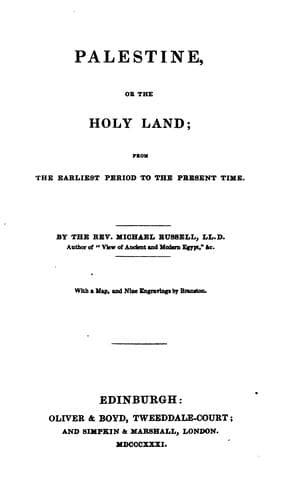
Palestine, or, the Holy Land: From the Earliest Period to the Present TimeRussell, Michael
History
Palestine, or, the Holy Land: From the Earliest Period to the Present Time
Russell, Michael
Palestine -- Description and travel; Palestine -- History
In reference to the tradition that the knights of Jerusalem held the
garrison of Bethulia forty years, Captain Mangles remarks, that the place
is too small to have contained even half the number of men which would
have been requisite to make any stand in such a country; and the ruins,
though they may be those of a place once defended by Franks, appear to
have had an earlier origin, as the architecture seems to be decidedly
Roman. There can be little doubt, indeed, that it is one of the works of
Herod the Great; and its distance does not differ much from that of
Herodium, which is described by Josephus as being about sixty furlongs
from the metropolis. The delineation of the hill, too, by the same
historian, corresponds with the Mount of the Franks; and when he adds that
water was conveyed to it at a great expense, we cannot permit ourselves to
question the identity of Herodium and the fortress of Bethulia.[108]
Hebron, Habroun, or, according to the Arabic orthography followed by the
moderns, El Hhalil, is considerably removed from the usual track of
pilgrims and tourists. An accident or quarrel once excited the indignation
of the inhabitants against the Franks, who during a long course of time
were dissuaded by the Monks at Jerusalem from extending their researches
beyond Bethlehem. Sandys could only report, apparently on the information
of others, that Hebron was reduced to ruins; but he adds, there is a
little village seated in the field of Machpelah, "where standeth a goodly
temple, erected over the burying-cave of the patriarchs by Helena, the
mother of Constantine, converted now into a mosque." Without minutely
analyzing the topography of this rather credulous author, we may repeat
the assurance which he gives relative to the existence of the imperial
monument dedicated to the memory of Abraham and his immediate descendants.
M. Burckhardt, who saw it in 1807, bears testimony to the fact that the
sepulchre, once a Greek church, is now appropriated to the worship of
Mohammed. The ascent to it is by a large and fine staircase that leads to
a long gallery, the entrance to which is by a small court. Towards the
left is a portico resting upon square pillars The vestibule of the temple
contains two rooms; the one being the tomb of Abraham, the other that of
Sarah. In the body of the church, between two large pillars on the right,
is seen a small recess, in which is the sepulchre of Isaac, and in a
similar one upon the left is that of his wife. On the opposite side of the
court is another vestibule, which has also two rooms, being respectively
the tomb of Jacob and of his spouse. At the extremity of the portico, upon
the right-hand, is a door which leads to a sort of long gallery that still
serves for a mosque; and passing from thence is observed another room
containing the ashes of Joseph, which are said to have been carried
thither by the people of Israel. All the sepulchres of the patriarchs are
Public-domain text, read in full here on John Shaqi.
Reviews
Reviews
No reviews yet
Be the first to share your thoughts on this work.
Elsewhere in the archive
Join the Discussion
Join the discussion
Sign in to leave a comment or review.
Sign InorCreate an account