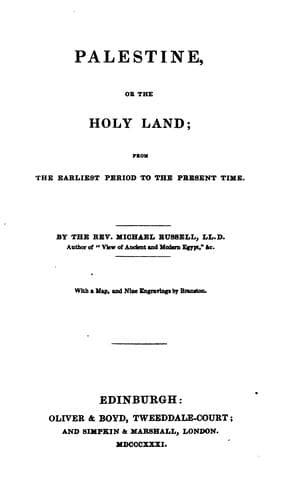
Palestine, or, the Holy Land: From the Earliest Period to the Present TimeRussell, Michael
History
Palestine, or, the Holy Land: From the Earliest Period to the Present Time
Russell, Michael
Palestine -- Description and travel; Palestine -- History
According to Strabo, there were thirteen towns swallowed up in the Lake
Asphaltites; Stephen of Byzantium reckons eight; the book of Genesis,
while it names five as situated in the Vale of Siddim, relates the
destruction of two only: four are mentioned in Deuteronomy, and five are
noticed by the author of Ecclesiasticus. Several travellers, and among
others Troilo and D'Arvieux, assure us, that they observed fragments of
walls and palaces in the Dead Sea. Maundrell himself was not so fortunate,
owing, he supposes, to the height of the water; but he relates that the
Father Guardian and Procurator of Jerusalem, both men of sense and
probity, declared that they had once actually seen one of these ruins;
that it was so near the shore, and the lake so shallow, that they,
together with some Frenchmen, went to it, and found there several pillars
and other fragments of buildings. The ancients speak more positively on
this subject. Josephus, who employs a poetical expression, says, that he
perceived on the shores of the Dead Sea the shades of the overwhelmed
cities. Strabo gives a circumference of sixty stadia to the ruins of
Sodom, which are also mentioned by Tacitus.[111]
It is surprising that no pains have been taken by recent travellers to
throw light upon this interesting point, or even to learn whether the
periodical rise and fall of the lake affords any means for determining the
accuracy of the ancient historians and geographers. Should the Turks ever
give permission, and should it be found practicable, to convey a vessel
from Jaffa to this inland sea, some curious discoveries would certainly be
made. Is it not amazing that, notwithstanding the enterprise of modern
science, the ancients were better acquainted with the properties, and even
the dimensions of the Lake Asphaltites, than the most learned nations of
Europe in our own times? It is described by Aristotle, Strabo, Diodorus
Siculus, Pliny, Tacitus, Solinus, Josephus, Galen, and Dioscorides. The
Abbot of Santa Saba is the only person for many centuries who has made the
tour of the Dead Sea. From his account we learn, through the medium of
Father Nau, that at its extremity it is separated, as it were, into two
parts, and that there is a way by which you may walk across it, being only
mid-leg deep, at least in summer; that there the land rises, and bounds
another small lake of a circular or rather an oval figure, surrounded with
plains and hills of salt; and that the neighbouring country is peopled by
innumerable Arabs.[112]
Public-domain text, read in full here on John Shaqi.
Reviews
Reviews
No reviews yet
Be the first to share your thoughts on this work.
Elsewhere in the archive
Join the Discussion
Join the discussion
Sign in to leave a comment or review.
Sign InorCreate an account