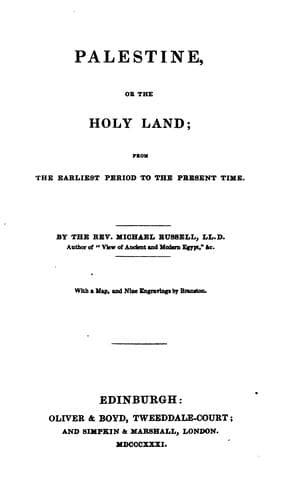
Palestine, or, the Holy Land: From the Earliest Period to the Present TimeRussell, Michael
History
Palestine, or, the Holy Land: From the Earliest Period to the Present Time
Russell, Michael
Palestine -- Description and travel; Palestine -- History
It is known that seven considerable streams fall into this basin, and
hence it was long supposed that it must discharge its superfluous stores
by subterranean channels into the Mediteranean or the Red Sea. This
opinion is now everywhere relinquished, in consequence of the learned
remarks on the effect of evaporation in a hot climate, published by Dr.
Halley many years ago; the justness of which were admitted by Dr. Shaw,
though he calculated that the Jordan alone threw into the lake every day
more than six million tuns of water. It is deserving of notice, that the
Arabian philosophers, if we may believe Mariti, had anticipated Halley in
his conclusions in regard to the absorbent power of a dry atmosphere.[113]
The marvellous properties usually assigned to the Dead Sea by the earlier
travellers have vanished upon a more rigid investigation. It is now known
that bodies sink or float upon it, in proportion to their specific
gravity; and that, although the water is so dense as to be favourable to
swimmers, no security is found against the common accident of drowning.
Josephus indeed asserts that Vespasian, in order to ascertain the fact now
mentioned, commanded a number of his slaves to be bound hand and foot and
thrown into the deepest part of the lake; and that, so far from any of
them sinking, they all maintained their place on the surface until it
pleased the emperor to have them taken out. But this anecdote, although
perfectly consistent with truth, does not justify all the inferences which
have been drawn from it. "Being willing to make an experiment," says
Maundrell, "I went into it, and found that it bore up my body in swimming
with an uncommon force; but as for that relation of some authors, that men
wading into it were buoyed up to the top as soon as they got as deep as
the middle, I found it, upon trial, not true."[114]
The water of this sea has been frequently analyzed both in France and
England. The specific gravity of it, according to Malte Brun, is 1.211,
that of fresh water being 1.000. It is perfectly transparent. The
applications of tests, or reagents, prove that it contains the muriatic
and sulphuric acids. There is no alumina in it, nor does it appear that it
is saturated with marine salt or muriate of soda. It holds in solution the
following substances, and in the proportions here stated:
Muriate of lime 3.920
Magnesia 10.246
Soda 10.360
Sulphate of lime .054
Public-domain text, read in full here on John Shaqi.
Reviews
Reviews
No reviews yet
Be the first to share your thoughts on this work.
Elsewhere in the archive
Join the Discussion
Join the discussion
Sign in to leave a comment or review.
Sign InorCreate an account