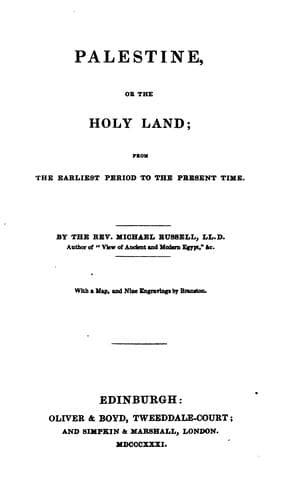
Palestine, or, the Holy Land: From the Earliest Period to the Present TimeRussell, Michael
History
Palestine, or, the Holy Land: From the Earliest Period to the Present Time
Russell, Michael
Palestine -- Description and travel; Palestine -- History
Rahhah stands about four miles nearer the river, or about half-way between
the assumed position of Jericho and the bank of the current. It consists
of about fifty dwellings, all very mean in their appearance, and every one
fenced in front with thorny bushes; one of the most effectual defences
that could be raised against the incursions of the Bedouins, whose horses
will not approach these formidable thickets. The inhabitants, without
exception, are professed believers in the creed of Islamism. Their habits
are those of shepherds rather than of cultivators of the soil; this last
duty, indeed, when performed at all, being done chiefly by the women and
children, as the men roam the plain on horseback, and derive the principal
means of subsistence from robbery and plunder. They are governed by a
sheik, whose influence among them is more like the authority of a father
over his children than that of a magistrate; and who is, moreover, checked
in the exercise of his power, by the knowledge that he would instantly be
deprived of life and station were he to exceed the bounds which, in all
rude countries, are opposed even to the caprices of despotism. It is
remarkable that the name of this village corresponds to Rahab, the name of
the hostess who received into her house the Hebrew spies, and signifies
odour or perfume; the slight change on the form of the Arabic term
implying no difference in the import of the root whence they are both
originally derived.
The mountains on the eastern side of the Jordan are more lofty than those
which skirt the Vale of Jericho, being not less than 2000 feet in height.
From the summit of a towering peak, which the traveller still delights to
recognise, Moses was permitted to behold the promised inheritance,
stretching towards the west, the south, and the north,--"All the land of
Gilead unto Dan, and all Naphtali, and the land of Ephraim, and Manasseh,
and all the land of Judah unto the utmost sea, and the south, and the
plain of the Valley of Jericho, the city of palm-trees, unto Zoar. And the
Lord said unto him, this is the land which I sware unto Abraham, unto
Isaac, and unto Jacob, saying, I will give it unto thy seed: I have caused
thee to see it with thine eyes, but thou shalt not go over thither. So
Moses, the servant of the Lord, died there, in the land of Moab, according
to the word of the Lord. And he buried him in a valley in the land of
Moab, over against Beth-peor: but no man knoweth of his sepulchre unto
this day."[118]
Public-domain text, read in full here on John Shaqi.
Reviews
Reviews
No reviews yet
Be the first to share your thoughts on this work.
Elsewhere in the archive
Join the Discussion
Join the discussion
Sign in to leave a comment or review.
Sign InorCreate an account