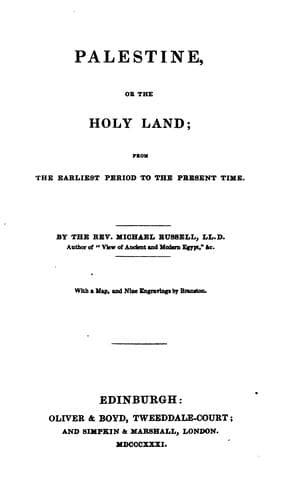
Palestine, or, the Holy Land: From the Earliest Period to the Present TimeRussell, Michael
History
Palestine, or, the Holy Land: From the Earliest Period to the Present Time
Russell, Michael
Palestine -- Description and travel; Palestine -- History
Josephus fixes the position of Jericho at the distance of one hundred and
fifty furlongs from Jerusalem, and sixty from the river Jordan; stating
that the country, as far as the capital, is desert and hilly, while to the
shores of the Lake Asphaltites it is low, though equally waste and
unfruitful. Nothing can apply more accurately, in all its particulars,
than this description does to the ruins just mentioned. The spot lies at
the very foot of the sterile mountains of Judea, which may be said
literally to overhang it on the west; and these ridges are still as
barren, as rugged, and as destitute of inhabitants as formerly, throughout
their whole extent, from the Lake of Tiberias to the Dead Sea. The
distance, by the computation in time, amounted to six hours, or nearly
twenty miles, from Jerusalem; the space between the supposed city and the
river being little more than one-third of that amount, the precise
proportion indicated by the Jewish historian.
The soil round Jericho was long celebrated for a precious balsam, which
used to be sold for double its weight of silver. The historian Justin
relates, that the trees from which it exudes bear a resemblance to firs,
though they are lower, and are cultivated after the manner of vines. He
adds, that the wealth of the Jewish nation arises from their produce, as
they grow in no other part of Syria. At present, however, there is not a
tree of any description, either palm or balsam, to be seen near the site
of this deserted town; but it is admitted, that the complete desolation
with which its ruins are invested ought to be attributed to the cessation
of industry rather than to any perceptible change either in the climate or
the soil.
Public-domain text, read in full here on John Shaqi.
Reviews
Reviews
No reviews yet
Be the first to share your thoughts on this work.
Elsewhere in the archive
Join the Discussion
Join the discussion
Sign in to leave a comment or review.
Sign InorCreate an account