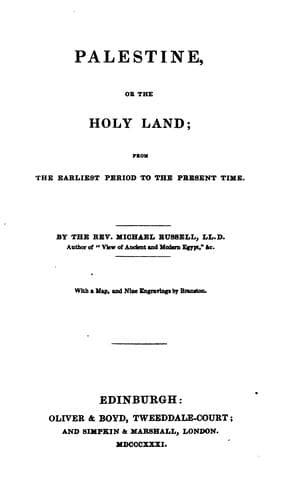
Palestine, or, the Holy Land: From the Earliest Period to the Present TimeRussell, Michael
History
Palestine, or, the Holy Land: From the Earliest Period to the Present Time
Russell, Michael
Palestine -- Description and travel; Palestine -- History
Refreshing himself at the fountain where our Lord and his apostles,
according to a venerable tradition, were wont to rest on their journey to
the holy city, the tourist sets his heart on revisiting the sacred remains
of that decayed metropolis. When at the summit of the Mount of Olives, he
is again struck with the mixture of magnificence and ruin which marks the
queen of nations in her widowed estate. Owing to the clear atmosphere and
the absence of smoke, the view is so distinct that one might count the
separate houses. The streets are tolerably regular, straight, and well
paved; but they are narrow and dull, and almost all on a declivity. The
fronts of the houses, which are generally two or three stories high, are
quite plain, simply constructed of stone, without the least ornament; so
that in walking past them a stranger might fancy himself in the galleries
of a vast prison. The windows are very few and extremely small; and, by a
singular whim, the doors are so low that it is commonly requisite to bend
the body nearly double in order to enter them. Some families have gardens
of moderate dimensions; but, upon the whole, the ground within the walls
is fully occupied with buildings, if we except the vast enclosures in
which are placed the mosques and churches.
There is not observed at Jerusalem any square, properly so called; the
shops and markets are universally opened in the public streets. Provisions
are said to be abundant and cheap, including excellent meat, vegetables,
and fruit. Water is supplied by the atmosphere; and preserved in capacious
cisterns; nor is it necessary, except when a long drought has exhausted
the usual stock, that the inhabitants should have recourse to the spring
near the brook Kedron. Rice is much used for food; but as the country is
quite unsuited to the production of that aquatic grain, it is imported
from Egypt in return for oil, the staple of Palestine.
There is a great diversity of costume, everybody adopting that which he
likes best, whether Arab, Syrian, or Turk; but the lower order of people
generally wear a shirt fastened round the waist with a girdle, after the
example of their neighbours in the desert. Ali Bey remarks, that he saw
very few handsome females in the metropolis; on the contrary, they had in
general that bilious appearance so common in the East,--a pale citron
colour, or a dead yellow, like paper or plaster, and, wearing a white
fillet round the circumference of their faces, they have not unfrequently
the appearance of walking corpses. The children, however, are much
healthier and prettier than those of Arabia and Egypt.
The Christians and Jews wear, as a mark of distinction, a blue turban. The
villagers and shepherds use white ones, or striped like those of the
Moslem. The Christian women appear in public with their faces uncovered,
as they do in Europe.
Public-domain text, read in full here on John Shaqi.
Reviews
Reviews
No reviews yet
Be the first to share your thoughts on this work.
Elsewhere in the archive
Join the Discussion
Join the discussion
Sign in to leave a comment or review.
Sign InorCreate an account