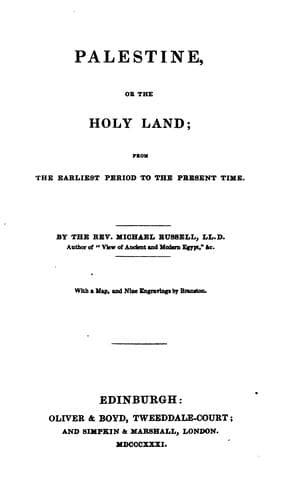
Palestine, or, the Holy Land: From the Earliest Period to the Present TimeRussell, Michael
History
Palestine, or, the Holy Land: From the Earliest Period to the Present Time
Russell, Michael
Palestine -- Description and travel; Palestine -- History
The arts are cultivated to a certain extent, but the sciences have
entirely disappeared. There existed formerly large schools belonging to
the harem; but there are hardly any traces of them left, if their place be
not supplied by a few small seminaries where children of every form of
worship learn to read and write the code of their respective religion. The
grossest ignorance prevails even among persons of high rank, who, on the
first interview, appear to have received a liberal education.[125]
The Arabic language is generally spoken at Jerusalem, though the Turkish
is much used among the better class. The inhabitants are composed of
people of different nations and different religions, who inwardly despise
one another on account of their varying opinions; but as the Christians
are very numerous, there reigns among the whole no small degree of
complaisance, as well as an unrestrained intercourse in matters of
business, amusement, and even of religion.[126]
It is well remarked by Chateaubriand, who had travelled among the native
tribes of North America as extensively as among the Arabs of the Syrian
wilderness, that amid the rudeness of the latter you still perceive a
certain degree of delicacy in their manners; you see that they are natives
of that East which is the cradle of all the arts, all the sciences, all
the religions. Buried at the extremity of the West, the Canadian inhabits
valleys shaded by eternal forests and watered by immense rivers; the Arab,
cast, as it were, upon the high road of the world between Africa and Asia,
roves in the brilliant regions of Aurora over a soil without trees and
without water.
The Jews--the children of the kingdom--have been cast out, and many have
come from the east and the west to occupy their place in the desolate land
promised to their fathers. They usually take up their abode in the narrow
space between the Temple and the foot of Mount Zion, defended from the
tyranny of their Turkish masters by their indigence and misery. Here they
appear covered with rags, and sitting in the dust, with their eyes fixed
on the ruins of their ancient sanctuary. It has been observed that those
descendants of Abraham who come from foreign countries to fix their
residence at Jerusalem live but a short time; while such as are natives of
Palestine are so wretchedly poor as to be obliged to send every year to
raise contributions among their brethren of Egypt and Barbary.[127]
The picture given by Dr. Richardson is much more flattering. He assures
his readers that many of the Jews are rich and in comfortable
circumstances; but that they are careful to conceal their wealth, and even
their comfort, from the jealous eye of their rulers, lest, by awakening
their cupidity, some plot of robbery or murder should be devised. The
whole population has been estimated by different travellers as amounting
to from fifteen to thirty thousand, consisting of Mohammedans, Jews, and
the various sects of Christians.
CHAPTER VII.
Public-domain text, read in full here on John Shaqi.
Reviews
Reviews
No reviews yet
Be the first to share your thoughts on this work.
Elsewhere in the archive
Join the Discussion
Join the discussion
Sign in to leave a comment or review.
Sign InorCreate an account