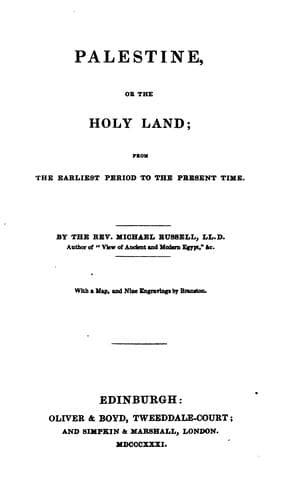
Palestine, or, the Holy Land: From the Earliest Period to the Present TimeRussell, Michael
History
Palestine, or, the Holy Land: From the Earliest Period to the Present Time
Russell, Michael
Palestine -- Description and travel; Palestine -- History
The ancient Shechem is one of the most prosperous towns in the Holy Land,
being still the metropolis of a rich and extensive country, and abounding
in agricultural wealth. Nor is there any thing finer than its appearance
when viewed from the heights by which it is surrounded. It strikes the eye
of the traveller who advances from the north, as being imbosomed in the
most delightful and fragrant bowers, half-concealed by rich gardens and
stately trees, collected into groves all round the beautiful valley in
which it stands. There is a considerable trade, as well as a flourishing
manufacture of soap; and the population has been reckoned as high as ten
thousand, an estimate, however, which Mr. Buckingham thinks somewhat
overrated. Within the town are six mosques, five baths, one Christian
church, an excellent covered bazaar for fine goods, and an open one for
provisions, besides numerous cotton-cloth manufactories, and shops of
every description. The inhabitants are chiefly Mohammedans. The Jews,
inheriting their ancient enmity towards the Samaritans, avoid the country
which the latter formerly possessed; while the Christians, alienated by
the suspicion of heresy among their brethren at Nablous, prefer the more
orthodox assemblies at Jerusalem and Nazareth.
The Samaritans themselves do not exceed forty in number. They have a
synagogue in the town, where they perform divine service every Saturday.
Four times a year they go in solemn procession to the old temple on Mount
Gerizim; on which occasion they meet before sunrise, and continue reading
the Law till noon. On one of these days they kill six or seven rams. They
have but one school in Nablous where their language is taught, though they
take much pride in preserving ancient manuscripts of their Pentateuch in
the original character. Mr. Connor saw a copy which is reported to be
three thousand five hundred years old, but was not allowed to examine, nor
even to touch it.
If any thing connected with the memory of past ages be calculated to
awaken local enthusiasm, the land around this city is eminently entitled
to that distinction. The sacred record of events transacted in the fields
of Shechem is from our earliest years remembered with delight. "Along the
valley," observes a late traveller, "we beheld a company of Ishmaelites
coming from Gilead, as in the days of Reuben and Judah, with their camels,
bearing spicery, and balm, and myrrh; who would gladly have purchased
another Joseph of his brethren, and-conveyed Him as a slave to some
Potiphar in Egypt. Upon the hills around flocks and herds were feeding as
of old; nor in the simple garb of the shepherds of Samaria was there any
thing to contradict the notions we may entertain of the appearance
formerly exhibited by the sons of Jacob."[134]
Public-domain text, read in full here on John Shaqi.
Reviews
Reviews
No reviews yet
Be the first to share your thoughts on this work.
Elsewhere in the archive
Join the Discussion
Join the discussion
Sign in to leave a comment or review.
Sign InorCreate an account