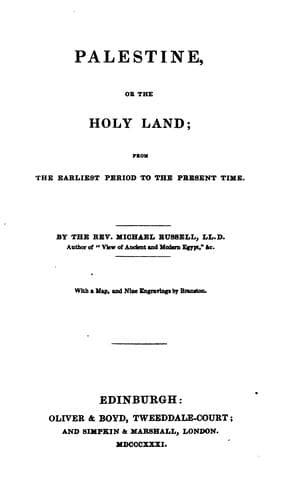
Palestine, or, the Holy Land: From the Earliest Period to the Present TimeRussell, Michael
History
Palestine, or, the Holy Land: From the Earliest Period to the Present Time
Russell, Michael
Palestine -- Description and travel; Palestine -- History
Every reader is aware that the Samaritans, whose principal residence since
the captivity has been at Shechem, have a place of worship on Mount
Gerizim, to which they repair at certain seasons to perform the rites of
their religion. It was upon the same hill, according to the reading in
their version of the Pentateuch, that the Almighty commanded the children
of Israel to set up great stones covered with plaster, on which to
inscribe the body of their law; to erect an altar; to offer
peace-offerings; and to rejoice before the Lord their God. In the Hebrew
edition of the same inspired books, Mount Ebal is selected as the scene of
these pious services;--a variation which the Samaritans openly ascribe to
the hatred and malignity of the Jews, who, they assert, have in this
passage corrupted the sacred oracles. In the immediate vicinity of the
town is seen a small mosque, which is said to cover the sepulchre of
Joseph, and to be situated in the field bought by Jacob from Hamor, the
father of Shechem, as is related in the book of Genesis, and alluded to by
St. John in the fourth chapter of his gospel.[132]
The road from Leban to Nablous, or Naplosa, is described by Dr. Clarke as
being mountainous, rocky, and full of loose stones. Yet, he adds, the
cultivation is everywhere marvellous; affording one of the most striking
pictures of human industry that it is possible to behold. The limestone
rocks and shingly valleys of Judea are entirely covered with plantations
of figs, vines, and olive-trees; not a single spot seemed to be neglected.
The hills, from their bases to their upmost summits, are overspread with
gardens; all of them free from weeds, and in the highest state of
improvement. Even the sides of the most barren mountains have been
rendered fertile, by being divided into terraces, like steps rising one
above another, upon which soil has been accumulated with astonishing
labour. A sight of this territory can alone convey any adequate idea of
its surprising produce; it is truly the Eden of the East, rejoicing in the
abundance of its wealth. The effect of this upon the people was strikingly
portrayed in their countenances. Instead of the depressed and gloomy looks
seen on the desolated plains belonging to the Pasha of Damascus, health
and hilarity everywhere prevailed. Under a wise and beneficent government,
the produce of the Holy Land, it is asserted, would exceed all
calculation. Its perennial harvests, the salubrity of its air, its limpid
springs, its rivers, lakes, plains, hills, and vales, added to the
serenity of its climate, prove this land to be indeed a "field which the
Lord hath blessed."[133]
Public-domain text, read in full here on John Shaqi.
Reviews
Reviews
No reviews yet
Be the first to share your thoughts on this work.
Elsewhere in the archive
Join the Discussion
Join the discussion
Sign in to leave a comment or review.
Sign InorCreate an account