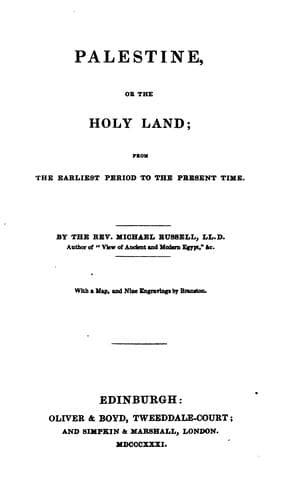
Palestine, or, the Holy Land: From the Earliest Period to the Present TimeRussell, Michael
History
Palestine, or, the Holy Land: From the Earliest Period to the Present Time
Russell, Michael
Palestine -- Description and travel; Palestine -- History
The ancient Samaria presents itself to the traveller in these days under
the name of Sebaste, or the Venerable,--an appellation conferred upon it
by Herod in honour of his patron Augustus. The Jewish historian describes
at length the buildings erected by the Idumean prince, especially a
citadel, and a noble temple which he intended to exhibit to future
generations as a specimen of his taste and munificence. He adds, that the
town was twenty furlongs in circumference, and distant one day's journey
from Jerusalem. It is computed by modern tourists to be more than forty
miles. The situation is extremely beautiful as well as naturally strong,
being placed on a large hill encompassed all round by a broad deep valley,
and therefore capable of an easy and complete fortification. But the
splendid city of Herod is now reduced to a village, small and poor,
exhibiting only the remains of its former greatness. In one place,
according to Dr. Richardson, there are sixty columns of the Ionic order
extended in a single row, marking the site of some gorgeous structure
erected by the vassal of Augustus. Mr. Buckingham counted eighty-three of
these pillars, and alludes to a tradition current among the natives, that
they formed part of Herod's own palace. This may be the edifice mentioned
by Josephus, who says that the king just named built a sacred place of a
furlong and a half in circuit, and adorned it with all sorts of
decorations; and therein constructed a temple remarkable both for its
largeness and its beauty.
Mr. Maundrell relates, that in his time the place where the city had stood
was entirely converted into gardens; and all the tokens that remain to
testify that there ever was such a metropolis are only a large square
piazza surrounded with pillars, and some poor ruins of a church, said to
have been built by the Empress Helena over the place where St. John the
Baptist was both imprisoned and beheaded. In the body of this temple you
go down a staircase into the very dungeon where that holy blood was shed.
The Turks hold the prison in great veneration, and over it have erected a
small mosque; but for a little piece of money they suffer you to go in and
satisfy your curiosity at pleasure.
A hundred and thirty years, aided by the destructive habits of
Mohammedans, seem to have made a deep impression upon the remains of
Sebaste; for when Dr. Clarke passed through it, he could not discover even
the relics of a great city, and was, therefore, disposed to question the
existence of the splendid ruins mentioned by Maundrell, and more minutely
described by Richardson and Buckingham. He is inclined to identify the
site of the ancient Samaria with the high ground on which stands the
castle of Santorri; but his reasoning is not sufficiently cogent to
satisfy the mind even of the least reflecting among his readers.
Public-domain text, read in full here on John Shaqi.
Reviews
Reviews
No reviews yet
Be the first to share your thoughts on this work.
Elsewhere in the archive
Join the Discussion
Join the discussion
Sign in to leave a comment or review.
Sign InorCreate an account