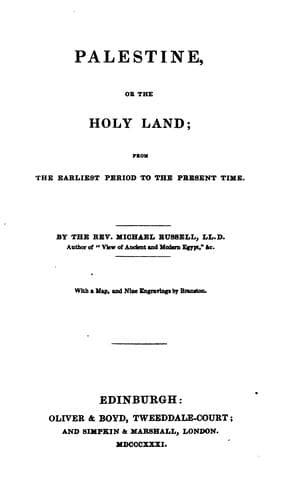
Palestine, or, the Holy Land: From the Earliest Period to the Present TimeRussell, Michael
History
Palestine, or, the Holy Land: From the Earliest Period to the Present Time
Russell, Michael
Palestine -- Description and travel; Palestine -- History
At this point we leave the territory of Ephraim, and pass into that of the
half-tribe of Manasseh. Pursuing his course northwards, the traveller
reaches a small hamlet called Bethamareen; and afterward, at the distance
of three or four miles, he finds himself at Gibba, a village surrounded
with trees bearing olives and pomegranates, and occupying a lofty station
over a narrow valley. This place is succeeded by Sannour, which appears to
be nothing more than a castle erected on an insular hill, and is more
commonly known by the name of Fort Giurali. Another village, called Abati,
presents itself on the right-hand, imbosomed in a grove of fruit trees;
but the stranger, desirous to proceed, advances along the valley until,
after having ascended a rising ground, he beholds stretched out at his
feet the fine plain of Esdraëlon covered with the richest pasture.[136]
On the slope of the hill which bounds the southern extremity of this
fertile valley stands the town of Jennin, a place, like most of the cities
of Palestine, more remarkable for decayed grandeur than for actual wealth,
beauty, or power. Its ancient name was Ginoa, and it is found recorded in
the works of some of the older writers as a frontier place between Samaria
and Galilee. The population at present is said to amount to about eight
hundred; but the ruins of a palace and a mosque prove that it once
possessed a greater importance than now belongs to it. Marble pillars,
fountains, and even piazzas still remain in a very perfect state; an
Arabic inscription over one of which induces the reader to believe that it
was erected by a commander named Selim.
Instead of pursuing our course towards Nazareth and the Lake of Tiberias,
we shall now cross the Jordan into the Land of Gilead, and lay before our
readers a brief outline of the discoveries which have been recently made
in that section of Palestine, the inheritance of Reuben and of Gad. We
have already remarked, that to the indefatigable exertions of Dr. Seetzen
the world are indebted for much of the knowledge they possess relative to
the ancient city of Geraza, the ruins of which are pointed out by the
Arabs under the name of Djarash.
Public-domain text, read in full here on John Shaqi.
Reviews
Reviews
No reviews yet
Be the first to share your thoughts on this work.
Elsewhere in the archive
Join the Discussion
Join the discussion
Sign in to leave a comment or review.
Sign InorCreate an account