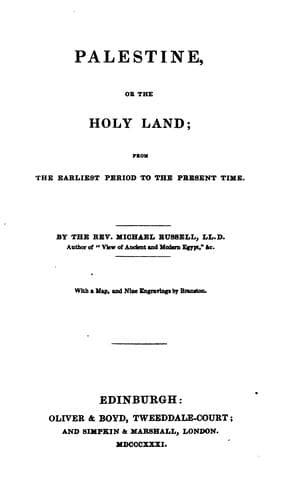
Palestine, or, the Holy Land: From the Earliest Period to the Present TimeRussell, Michael
History
Palestine, or, the Holy Land: From the Earliest Period to the Present Time
Russell, Michael
Palestine -- Description and travel; Palestine -- History
About six miles from Djerash towards the north stands the village of Souf,
on the brow of a lofty hill, and flanked by a deep ravine. It retains
several marks of having been the site of some more ancient and
considerable town, presenting large blocks of stone with mouldings and
sculpture wrought into the modern buildings. In the neighbourhood are seen
the walls of an edifice apparently Roman, as also the ruins of two small
towers which may with equal certainty be traced to the age of Saracenic
domination. Souf can boast of nearly five hundred inhabitants, all rigid
Mohammedans, and remarkable for a surly and suspicious character.
Leaving this rather inhospitable village, the traveller who wishes to
visit the remains of Gamala proceeds in a north-westerly direction,
descending into a fine valley, and again rising on a gentle ascent, the
whole being profusely and beautifully wooded with evergreen oaks below,
and pines upon the ridge of the hill above. "Mr. Bankes, who had seen the
whole of England, the greater part of Italy and France, and almost every
province of Spain and Portugal, frequently remarked, that in all his
travels he had met with nothing equal to it, excepting only in some parts
of the latter country,--Entre Minho and Douro,--to which alone he could
compare it."[140]
Several hamlets and some obscure indications of ancient buildings meet the
eye in course of the journey to Om Keis. Before reaching this town, the
road emerges into a hilly district, bleak, rocky, and ill-cultivated. The
view is as monotonous as that from Jerusalem, forming a striking contrast
to the rich, verdant, and beautiful scenery which distinguishes Bashan and
Gilead.
Gamala, for under that name the ruins of the Roman station are most
familiarly known, must have covered a site nearly square; its greatest
length, from east to west, being seventeen hundred short paces, and its
breadth about one-fourth less. A considerable portion of it seems to have
stood on the summit of a hill, well fortified all round; the traces of
towers and other works of defence being still visible even on its steepest
parts. The portals of the eastern gate remain, from whence a noble street
appears to have run through the whole length of the city, lined by a
handsome colonnade of Ionic and Corinthian pillars. The pavement is formed
of square blocks of black volcanic stone, and is still so perfect, that
the ruts of wheel-carriages are to be seen in it, of different breadths
and about an inch in depth, as at the ruins of Pompeii and
Herculaneum.[141]
Public-domain text, read in full here on John Shaqi.
Reviews
Reviews
No reviews yet
Be the first to share your thoughts on this work.
Elsewhere in the archive
Join the Discussion
Join the discussion
Sign in to leave a comment or review.
Sign InorCreate an account