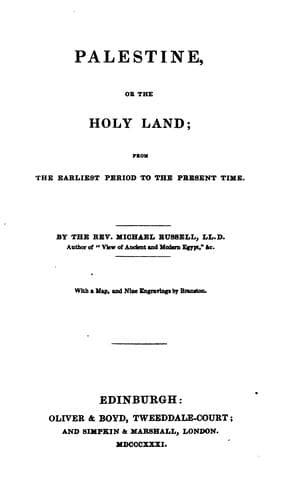
Palestine, or, the Holy Land: From the Earliest Period to the Present TimeRussell, Michael
History
Palestine, or, the Holy Land: From the Earliest Period to the Present Time
Russell, Michael
Palestine -- Description and travel; Palestine -- History
The first edifice which presents itself on entering the eastern gate is a
theatre, the scene and front of which are entirely destroyed, but the
benches are preserved. Still farther on are appearances of an Ionic
temple, the colonnade of the street being continued; and about half-way
along is a range of Corinthian pillars on pedestals, marking the position
of some grand edifice. Not a column, indeed, continues erect, but the plan
can be distinctly traced. This supposed temple must have been a hundred
paces in depth from north to south; and its façade, which fronted the
street and came in a line with the grand colonnade already mentioned,
cannot have been less than a hundred and eighty feet in breadth. The chief
peculiarity of this structure, however, consists in its having been built
on a range of fine arches, so that its foundations were higher than the
general level of the town; and hence, as the pedestals of the columns were
elevated considerably above the street, it must have presented a very
striking object.
There are the remains of numerous other edifices, theatres, and temples,
but they are all too indistinct to enable even a professional eye to
pronounce with confidence on their plan and particular purpose. The
prevalent orders of architecture are Ionic and Corinthian, though some few
capitals decidedly Doric are discovered among the ruins. The stone
generally used throughout the city is that of the neighbouring
mountains,--a species of gray rock approaching to a carbonate of lime; but
the shafts of some of the pillars are formed of a black substance,
supposed to have a volcanic origin, and most commonly preferred for the
internal decorations of funereal vaults and sarcophagi.[142]
As the ruins here described are not immediately on the position usually
assigned to Gamala on the maps, and as Dr. Seetzen, the only person
besides Mr. Buckingham who has published any account of them, thinks that
they are those of Gadara, the latter enters into a lengthened discussion
in support of his own views, calling in the authority of several ancient
writers to establish his position. The reader will find that much of the
ambiguity which prevails on this point arises from the fact of there being
in different parts of Canaan several towns of the same name. For example,
there was unquestionably a place called Gadara on the eastern shore of the
Lake of Tiberias; while from the testimony of Josephus, it is equally
certain that the same appellation was given to the capital of Perea. In
the New Testament, the country of the Gadarenes is described as being on
the other side of the sea, over-against Galilee, a notice which removes
all doubt from the opinion of those who maintain the existence of a town
or village, named Gadara; situated to the northward of the site generally
claimed for Gamala, and nearer the body of the lake.
Public-domain text, read in full here on John Shaqi.
Reviews
Reviews
No reviews yet
Be the first to share your thoughts on this work.
Elsewhere in the archive
Join the Discussion
Join the discussion
Sign in to leave a comment or review.
Sign InorCreate an account