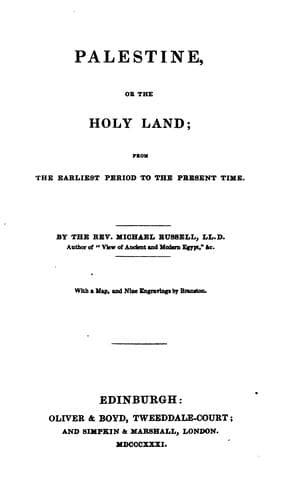
Palestine, or, the Holy Land: From the Earliest Period to the Present TimeRussell, Michael
History
Palestine, or, the Holy Land: From the Earliest Period to the Present Time
Russell, Michael
Palestine -- Description and travel; Palestine -- History
At about an hour and a half towards the north-east, situated on the slope
of a hill, stands Kefer Kenna, or Cana of Galilee, the village where the
Redeemer performed his first miracle. Here, in a small church belonging to
the Greek communion, is shown an old stone pot made of the common rock of
the country, and which is said to be one of the original vessels that
contained the water afterward converted into wine. It is worthy of note,
says Dr. Clarke, that in walking among the ruins of Cana one sees large
massy pots of stone answering to the description given by the evangelist;
not preserved nor exhibited as relics, but lying about disregarded by the
present inhabitants, as antiquities with the original use of which they
are altogether unacquainted. From their appearance, and the number of
them, it is quite evident that the practice of keeping water in large
stone pots, each holding from eighteen to twenty-seven gallons, was once
common in the country.
The remains of the house in which the marriage was celebrated are likewise
pointed out to the traveller, who, at the present day, is permitted to
examine curiosities with greater deliberation than was allowed to honest
Doubdan.[159] This pious confessor, whose zeal prompted him to leave
nothing unexplored, found an old church in the village, ascribed as usual
to the inexhaustible beneficence of St. Helena; but his attention was more
pleasantly engaged in tracing the course of the stream which issues from
the sacred fountain whence the water was drawn for the marriage-feast.
There is still a limpid spring near the village; which affords to the
inhabitants their daily supply of a delicious beverage. Pilgrims repair to
it moved by feelings of piety, or, as Doubdan expresses it, to satisfy at
once their devotion and their thirst. A few olive-trees being near the
spot, travellers alight, spread their carpets, and having filled their
pipes, generally smoke tobacco and take some coffee; always preferring
repose in these places to any accommodations which can be obtained in the
village. Such has been the custom of the country from time immemorial,
extending, not only to the wayfaring man, but also to the shepherds on the
surrounding hills, and to the companies of merchantmen whose trade carries
them through the neighbouring deserts.[160]
Public-domain text, read in full here on John Shaqi.
Reviews
Reviews
No reviews yet
Be the first to share your thoughts on this work.
Elsewhere in the archive
Join the Discussion
Join the discussion
Sign in to leave a comment or review.
Sign InorCreate an account