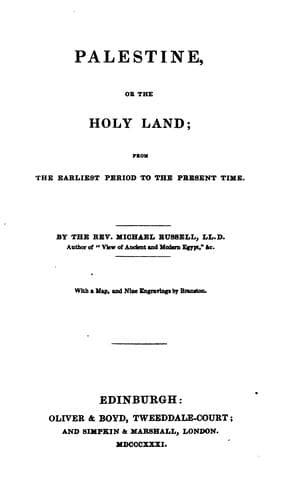
Palestine, or, the Holy Land: From the Earliest Period to the Present TimeRussell, Michael
History
Palestine, or, the Holy Land: From the Earliest Period to the Present Time
Russell, Michael
Palestine -- Description and travel; Palestine -- History
As we must now leave the interior of Palestine, and return to the shore of
the Mediterranean, we cannot do more at this advanced stage of our
progress than take a distant view of the landscape which stretches from
the lake of Tiberias to the sources of the Jordan. The mountains that
terminate the prospect are extremely magnificent, some of them being
covered with perpetual snow. The intervening country, too, is in many
parts uncommonly fine, presenting luxuriant crops, thriving villages, and
other tokens of security and comfort. The Jordan issues from Lake Hoole,
or Julias, which in its turn is fed by so many streams, that it becomes
very difficult to determine the true fountain of the sacred river.
The only town of consequence between the ruins of Capernaum and the alpine
range of Hermon and Djibbel el Sheik is Saphet, already mentioned, being
one of the four cities consecrated by the religious veneration of the
Hebrews. According to Burckhardt, it stands upon several low hills that
divide it into quarters, the largest of which is occupied by Jews. The
whole may contain six hundred houses, of which one hundred and fifty
belong to the people just named, and nearly as many to the Christians. The
summit of the principal eminence is crowned with an ancient castle, part
of which is regarded by the descendants of Israel as being contemporary
with their earliest kings.
Saphet is still a sort of university for the education of the Jewish
rabbis, of whom there are usually twenty of thirty resident, collected
from different countries of Europe, Africa, and Asia. They have no fewer
than seven synagogues. Their attachment to this place arises from various
motives, and especially from the traditionary belief that the Messias is
to reign here forty years before he assumes the government at Jerusalem.
To the north of the hill on which the castle stands there are several
wells, which, it is said, were dug by the patriarch Isaac, and became the
cause of contention between his herdsmen and those of Gerar; but, says
Pococke, they have much mistaken the place, the Valley of Gerar being at a
great distance on the other side of Jerusalem. This town, which is only
mentioned in the book of Tobit as belonging to the tribe of Naphtali,
became famous during the Crusades; it was occupied also by a detachment of
French troops during the invasion of the country by Bonaparte.
Public-domain text, read in full here on John Shaqi.
Reviews
Reviews
No reviews yet
Be the first to share your thoughts on this work.
Elsewhere in the archive
Join the Discussion
Join the discussion
Sign in to leave a comment or review.
Sign InorCreate an account