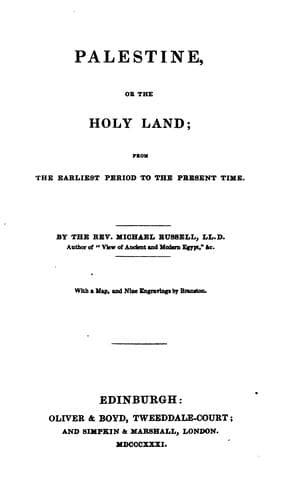
Palestine, or, the Holy Land: From the Earliest Period to the Present TimeRussell, Michael
History
Palestine, or, the Holy Land: From the Earliest Period to the Present Time
Russell, Michael
Palestine -- Description and travel; Palestine -- History
The date of this building is incidently mentioned by Epiphanius, who
relates that one Joseph, a native of Tiberias, was authorized by
Constantine to erect a, number of such edifices in the Holy Land, and that
he fulfilled the intention of his sovereign at Tiberias, Capernaum, and
Diocesarea. Reland, upon the authority of Theophanes, places its
destruction in the year 339 of the Christian era, when the town was
demolished on account of the seditious conduct of its inhabitants.
It is perhaps worthy of notice, that Dr. Clarke examined some pictures
which had been recently discovered among these ruins. One appears to
represent the interview between our Saviour and the two disciples at
Emmaus, when in the set of making himself known to them by the breaking of
bread. Another exhibits the Virgin bearing in swaddling-clothes the infant
Jesus; and a third seems to illustrate the same subject in circumstances
somewhat different. They are said to bear a great resemblance to those
used in the churches of Russia, being executed upon a square piece of wood
about half an inch in thickness. As they were not valued highly by the
person into whose hands they had accidently fallen, the Englishman
bestowed a trifle on the ignorant Mohammedan, and "took them into safer
custody."[163]
The vale of Zabulon divides the village just described from the ridge of
hills which look down on Acre and the shores of the Great Sea. This
delightful plain appears everywhere covered with spontaneous vegetation,
flourishing in the wildest exuberance. The scenery is described by Dr.
Clarke as not less beautiful than that of the rich valleys upon the south
of the Crimea. It reminded him of the nest parts of Kent and Surrey. The
prickly-pear, which grows to a prodigious size in the Holy Land, sprouts
luxuriantly among the rocks, displaying its gaudy yellow blossoms, and
promising abundance of a delicious cooling fruit. Off either side of the
road the ruins of fortified places exercise the ingenuity of the
antiquarian traveller, who endeavours, through the mist of tradition and
the perplexing obscurity of modern names, to identify towns which make a
figure in Jewish and Roman history. All remains of the strong city of
Zabulon, called by Josephus the "city of men," have disappeared; and its
"admirable beauty," rivalling that of Tyre, Sidon, and Berytus, is now
sought for in vain among Arab huts and scattered stones.
Public-domain text, read in full here on John Shaqi.
Reviews
Reviews
No reviews yet
Be the first to share your thoughts on this work.
Elsewhere in the archive
Join the Discussion
Join the discussion
Sign in to leave a comment or review.
Sign InorCreate an account