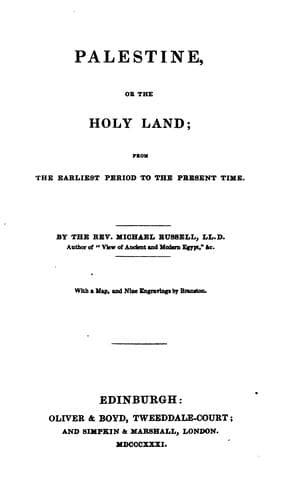
Palestine, or, the Holy Land: From the Earliest Period to the Present TimeRussell, Michael
History
Palestine, or, the Holy Land: From the Earliest Period to the Present Time
Russell, Michael
Palestine -- Description and travel; Palestine -- History
assuaged the stern temper of the Jews. Awakened from their dream of
prophecy and conquest, they assumed the behaviour of peaceable and
industrious subjects. Their hatred of mankind, instead of flaming out in
acts of blood and violence, evaporated in less dangerous gratifications.
They embraced every opportunity of overreaching the idolaters in trade;
and they pronounced secret and ambiguous imprecations against the haughty
kingdom of Edom, the name under which they were pleased to denounce the
Roman empire.[166]
The glories which were shed upon Palestine by the munificent zeal of
Constantine and his mother have already been repeatedly mentioned. The
splendid buildings which arose in every part of the Holy Land announced
the triumph of the new faith in the country where it had its origin;
exciting at once the pride of the Christian, and the jealousy, resentment,
and despair of the Jew. The government of Constantius was not more
favourable to the children of Israel; nor was it till the accession of
Julian that they were encouraged to look for revenge upon their enemies,
if not for protection to their despised countrymen. The edict to rebuild
the Temple on Mount Moriah, and to establish once more at Jerusalem the
worship enjoined by Moses, called forth their utmost exertions in behalf
of a prince who at least abandoned a rival religion, destined, as they
apprehended, to supplant their own more ancient ritual.
The issue of this attempt to reinstate the ceremonies of the Jewish Law in
the capital of Palestine is known to every reader. The workmen employed in
digging the foundation of the new Temple were terrified by flames of fire
darting forth from the ground, and accompanied with the most frightful
explosions. No inducement could prevail on them to persevere in labours
which appeared to excite the anger of Heaven. The enterprise was
relinquished, as at once hopeless and impious; and there is no doubt that,
whatever additions may have been made to the circumstances by ignorance
and a too easy belief, the views of Julian were frustrated by the
occurrence of some very extraordinary event, which still finds a place
even in Roman history. The skeptic may smile when he reads in the pages of
a Christian Father, that flakes of fire which assumed the form of a cross
settled on the dresses of the artisans and spectators; that a horseman was
seen careering amid the flames; and that, when the affrighted labourers
fled to a neighbouring church, its doors, fastened by some preternatural
force within, refused to admit them into the sacred building. In such
details the imagination is consulted more than the reason; and it cannot
be denied that certain authors, who wrote long after the reign of Julian;
have admitted traditionary anecdotes into the narrative of a grave event.
It is deserving of notice, however, that the mark of the cross, said to
have been impressed upon the bystanders, is not the most incredible of the
circumstances recorded.
Public-domain text, read in full here on John Shaqi.
Reviews
Reviews
No reviews yet
Be the first to share your thoughts on this work.
Elsewhere in the archive
Join the Discussion
Join the discussion
Sign in to leave a comment or review.
Sign InorCreate an account