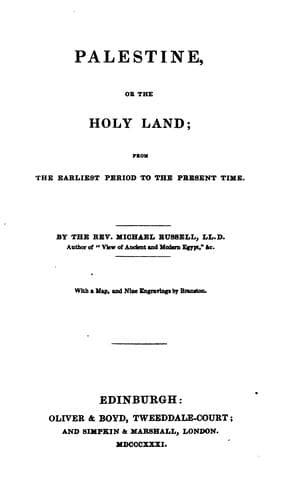
Palestine, or, the Holy Land: From the Earliest Period to the Present TimeRussell, Michael
History
Palestine, or, the Holy Land: From the Earliest Period to the Present Time
Russell, Michael
Palestine -- Description and travel; Palestine -- History
Many instances have been known of persons touched
by the electric fluid, whose bodies exhibited similar traces of its
operation,--straight lines cutting one another at right angles--and hence
that part of the description which appears the least entitled to belief
will be found to be strictly within the limits of nature.[167]
The policy of the emperors continued to depress the Jews in Palestine,
while it granted to them the enjoyment of considerable privileges in all
the other provinces where their presence and peculiar views were less
hazardous to the public peace. During the same period, the Christian
church possessed the countenance of the civil power, and gradually
extended its doctrines into Armenia, as well as into the more important
region of the Lower Mesopotamia. It was not till the beginning of the
seventh century that the course of events was materially disturbed by an
invasion of the Persians, under Chosroes, who had resolved to humble the
government of Constantinople, and to check its pretensions in the East.
The part of the army appointed to serve against Palestine was entrusted
to Carnsia, an experienced general, who invited the Jews to join his
standard. This people, ever ready to aid the cause of revolt, assembled,
it is said, to the number of 24,000 men, and made preparations for an
attack on Jerusalem. A sanguinary warfare had ensued, even before the
arrival of their allies from beyond the Euphrates; and both sides,
accordingly, were exasperated to the highest degree of fury, and
importuning Heaven to hasten the moment of revenge. The Christians within
the walls massacred their enemies in cold blood, while the assailants
without carried destruction to every point which their arms could reach.
At length, the advance of the Persians secured to the Jews the hour of
triumph and retaliation, when they fully quenched their thirst for
vengeance in the blood of the Nazarenes. The victors are said to have
sold the miserable captives for money. But the rage of the Jews was
stronger than their avarice; for not only did they not scruple to
sacrifice their treasures in the purchase of these devoted bondsmen at a
lavish price, but they put to death without remorse all whom they bought.
It was rumoured that no fewer than 90,000 Christians perished. Every
church was demolished, including that of the Holy Sepulchre,--the
greatest object of Jewish hatred. The stately building of Helena and
Constantine was abandoned to the flames, and the devout offerings of
three hundred years were rifled in one sacrilegious day.
Public-domain text, read in full here on John Shaqi.
Reviews
Reviews
No reviews yet
Be the first to share your thoughts on this work.
Elsewhere in the archive
Join the Discussion
Join the discussion
Sign in to leave a comment or review.
Sign InorCreate an account