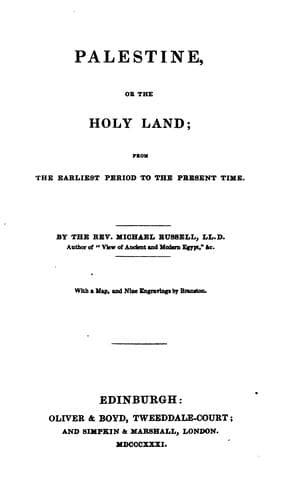
Palestine, or, the Holy Land: From the Earliest Period to the Present TimeRussell, Michael
History
Palestine, or, the Holy Land: From the Earliest Period to the Present Time
Russell, Michael
Palestine -- Description and travel; Palestine -- History
Many attempts have been made to defend the policy and excuse the
enormities of the Christian warriors in their enterprise against the
Moslem occupants of the Holy Land. These two points ought to be more
carefully distinguished than they usually are, whether in the pages of
friends or enemies; for while the general expediency of a combination of
the Christian powers may be supported on good grounds, the cruelty of some
of their measures deserves the severest censure. It is remarked by Mr.
Mills, that the massacre of the Saracens on the capture of the holy city
did not proceed alone from the inflamed passions of victorious soldiers,
but from remorseless fanaticism. Benevolence to Turks, Jews, infidels, and
heretics made no part of Christian ethics in those rude times; and as the
Moslem in their consciences believed it was the will of Heaven that the
religion of their prophet should be propagated by the sword, so their
antagonists laboured under the mental delusion that they themselves were
the ministers of God's wrath on a disobedient and stiff-necked people. The
Latins, on the day after the victory, massacred three hundred men, to whom
Tancred and Gaston de Bearn had promised protection, and even given a
standard as a pledge of safety. But every engagement was broken, in
consequence of the resolution that no pity should be shown to the
Mohammedans,--an expedient which was justified by the opinion now
prevalent among the invaders, that in conjunction with the Saracens of
Egypt they might again reduce the city and recover all the ground they had
lost. It was for this reason that the inhabitants of Jerusalem, armed and
unarmed, were dragged forth into the public squares, and slain like
cattle. Women with children at the breast, boys, and even girls were
slaughtered indiscriminately, and in such numbers that the streets were
covered with dead bodies and mangled limbs. No heart melted into
compassion or expanded into benevolence. The stones of the city were
ordered to be washed, and the melancholy task was performed by some Moslem
slaves. The Count of Toulouse, whose avarice prevailed over his
superstition, was loudly condemned for accepting a ransom from a few of
the devoted prisoners, whom he sent in safety to Ascalon. So unrelenting,
in short, was the passion of revenge among the crusaders, that they set
fire to the synagogues of the Jews, many of whom perished in the
flames.[170]
Public-domain text, read in full here on John Shaqi.
Reviews
Reviews
No reviews yet
Be the first to share your thoughts on this work.
Elsewhere in the archive
Join the Discussion
Join the discussion
Sign in to leave a comment or review.
Sign InorCreate an account