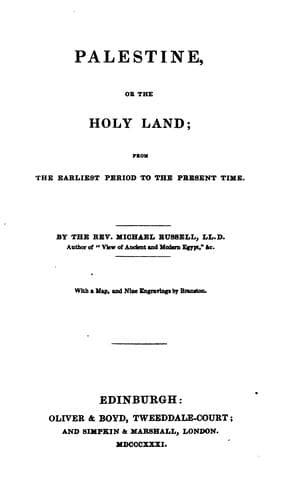
Palestine, or, the Holy Land: From the Earliest Period to the Present TimeRussell, Michael
History
Palestine, or, the Holy Land: From the Earliest Period to the Present Time
Russell, Michael
Palestine -- Description and travel; Palestine -- History
Such conduct merits the deepest execration that moralist or statesman may
be pleased to pour upon it. We are nevertheless convinced that, in the
peculiar circumstances of the Christian world when Peter the Hermit called
its chiefs to arms, a united war against the Mohammedan states of Syria
was dictated by the soundest political wisdom. The subjects of Omar had
already conquered an establishment in Sicily and Spain, and attempted the
subjugation of France. Their views were directed towards universal
dominion in the West, as well as in the East; they hoped to witness the
triumph of the crescent in Europe not less certainly than in Asia, and to
be able to impose a tribute on the worshippers of Christ, or compel them
to relinquish their creed on the remotest shores of the Atlantic. Those,
therefore, who perceive in the Crusades nothing but a mob of armed
pilgrims running to rescue a tomb in Palestine must take a very limited
view of history. The point in question was not merely the recovery of that
sacred building from the hands of infidels, but rather to decide which of
the two religions, the Christian or Mohammedan, should predominate in the
world; the one hostile to civilization, and only favourable to ignorance,
despotism, and slavery; the other friendly to improvement, learning, and
freedom in all ranks and conditions of society.
It is asserted by Chateaubriand, that whoever reads the address of Pope
Urban to the council of Clermont must be convinced that the leaders in
these military enterprises were not actuated by the petty views which have
been ascribed to them; but, on the contrary, that they aspired to save the
Western World from a new inundation of barbarians. The spirit of Islamism
is conquest and persecution; the gospel, on the contrary, inculcates only
toleration and peace. The Christians, moreover, had endured for several
centuries all the oppressions which the fanaticism of the Saracens
impelled them to exercise. They had merely endeavoured to interest
Charlemagne in their favour; for neither the conquest of Spain, the
invasion of France, the pillage of Greece and the Two Sicilies, nor the
entire subjugation of Africa, could for nearly six hundred years rouse the
Christians to arms. If at last the cries of numberless victims slaughtered
in the East, if the progress of the barbarians, who had already reached
the gates of Constantinople, awakened Christendom, and impelled it to rise
in its own defence, who can say that the cause of the Holy Wars was
unjust? Contemplate Greece, if you would know the fate of a people
subjected to the Mussulman yoke. Would those who at this day so loudly
exult in the progress of knowledge wish to live under a religion that
burned the Alexandrian library, which makes a merit of trampling mankind
under foot, and holding literature and the arts in sovereign contempt? The
Crusades, by weakening the Moslem hordes in the very centre of Asia,
Public-domain text, read in full here on John Shaqi.
Reviews
Reviews
No reviews yet
Be the first to share your thoughts on this work.
Elsewhere in the archive
Join the Discussion
Join the discussion
Sign in to leave a comment or review.
Sign InorCreate an account