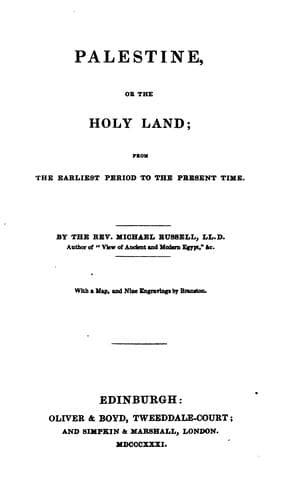
Palestine, or, the Holy Land: From the Earliest Period to the Present TimeRussell, Michael
History
Palestine, or, the Holy Land: From the Earliest Period to the Present Time
Russell, Michael
Palestine -- Description and travel; Palestine -- History
But the experience of their predecessors, fifty years before, was lost
upon these fearless soldiers of the Cross. Without suitable preparation,
they encountered the dangers of a long march through hostile countries and
sickly climates, the effects of which appeared in the rapid diminution of
their numbers, in mutual invectives, and in increasing despair. Not more
than a tenth part of the Germans reached the coast of Syria. The French,
who had suffered less than their allies, were sooner ready to take the
field against the Saracens; and after proving their arms in a few
unimportant skirmishes, they resolved to lay siege to Damascus in concert
with the battalions of Conrade. But the evil genius of intrigue defeated
their designs. After a fruitless display of force more than sufficient to
have reduced the place, the Christian chiefs withdrew from before the
ramparts of the Syrian capital, and fell back upon Jerusalem in sorrow and
shame. Conrade soon returned to Europe with the shattered remains of his
gallant host; and about a year afterward his example was imitated by the
French king and the greater number of his generals, who were disgusted
with the narrow policy on which the war had been conducted.
Baldwin the Third, dying without male issue, transmitted the precarious
throne of Jerusalem to his brother Amaury, or Almeric; who, after of a
reign of eleven years, was succeeded by his son, Baldwin the Fourth. The
young sovereign, being incapable of the duties of government, passed his
minority under the wise counsels of Raymond, Count of Tripoli, who
endeavoured to sustain the weight of kingly power in the midst of very
formidable enemies. The name of Noureddin was long terrible to the
Christians of Palestine, who had gradually lost their warlike virtues; but
they were now about to encounter a still more able, and much more
celebrated antagonist, in the person of Saladin, the hero of the Crescent,
and one of the most distinguished leaders of that very romantic age.
Baldwin had given his sister Sybilla, widow of William, surnamed
Longue-Epée, or the Long-sword, in marriage to Guy of Lusignan. The
grandees of the kingdom, dissatisfied with the choice, divided into
parties. The king, dying in 1184, left for his heir Baldwin the Fifth, the
son of Sybilla and William just mentioned, a child not more than eight
years of age, and who soon afterward sunk under a constitutional
distemper. His mother caused the crown to be conferred on her husband, the
ambitious Guy,--a measure which did not allay the jealousy of the nobles
who had opposed their union. An alarming dissension prevailed among the
barons, some of whom refused to take the oath of allegiance to the new
sovereign, and even offered the diadem to Humphrey de Thoron. But the
intrigues of Sybilla and the terror of Saladin prevented an open rupture,
while events of a more important nature were about to occupy the attention
of either party.
Public-domain text, read in full here on John Shaqi.
Reviews
Reviews
No reviews yet
Be the first to share your thoughts on this work.
Elsewhere in the archive
Join the Discussion
Join the discussion
Sign in to leave a comment or review.
Sign InorCreate an account