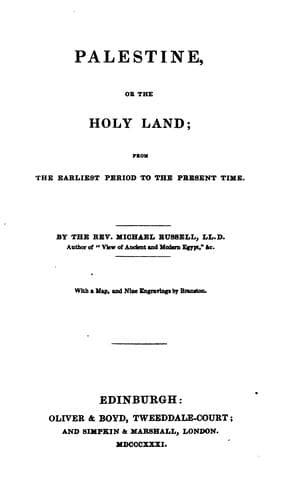
Palestine, or, the Holy Land: From the Earliest Period to the Present TimeRussell, Michael
History
Palestine, or, the Holy Land: From the Earliest Period to the Present Time
Russell, Michael
Palestine -- Description and travel; Palestine -- History
The sultan had received from several of the Christian warriors just ground
of offence, and failing to obtain redress from the feeble government of
Jerusalem, he took the field in order to chastise with his own hand the
more guilty of the aggressors. He encamped near the Lake of Tiberias,
where Guy, listening to counsellors who saw not the danger of placing the
fortunes of the kingdom on the issue of a single battle, resolved to
attack him. For a whole day the engagement was in suspense, and at night
the Latins retired to some rocks in the neighbourhood, hoping that they
might find a little water to quench their thirst. At the approach of dawn
the two armies stood for a while gazing upon each other, as if conscious
that the fate of the Moslem and the Christian worlds was in their hands.
But no sooner did the sun appear than the Crusaders raised their war-cry,
and the Turks sounded their trumpets and atabals,--a mutual challenge to
renew the sanguinary conflict. Thi bishops and clergy ran through the
ranks cheering the soldiers of the church. A fragment of the true cross,
intrusted to the knights of the Holy Sepulchre, was placed on a hillock,
around which the broken squadrons repeatedly rallied, and recovered
strength for the combat whereon the interests of their faith were
suspended. But the Crescent, supported by more numerous and stronger
hands, triumphed on the plain of Tiberias. The Christians were defeated
with great loss; the king, the Master of the Templars, and the Marquis of
Montferrat were taken prisoners, and the piece of holy wood, in which they
had put their trust, was snatched from the grasp of the Bishop of Acre.
This victory placed the greater part of Palestine in the power of
Saladin, who, upon the whole, used his success with moderation and
clemency. The fugitives from every quarter fled to Jerusalem, hoping to
escape in that asylum the swords and fetters of the Turks. One hundred
thousand persons are said to have been crowded within the walls; but so
few were the soldiers, and so feeble was the government of the queen,
that the holy city presented no serious obstacle to the progress of the
Moslem arms. Saladin declared his unwillingness to stain with human blood
a place which even the followers of the Prophet held in reverence, as
having been sanctified by the presence of many inspired individuals. He
therefore promised to the people, on condition that they would quietly
surrender the city, a supply of money, and lands in the most fertile
provinces of Syria.
Public-domain text, read in full here on John Shaqi.
Reviews
Reviews
No reviews yet
Be the first to share your thoughts on this work.
Elsewhere in the archive
Join the Discussion
Join the discussion
Sign in to leave a comment or review.
Sign InorCreate an account