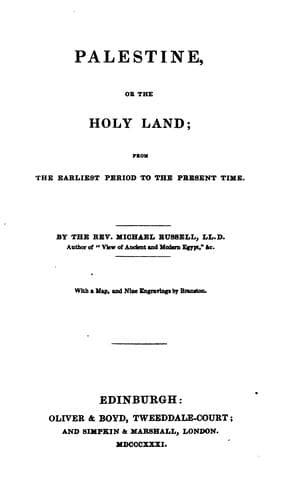
Palestine, or, the Holy Land: From the Earliest Period to the Present TimeRussell, Michael
History
Palestine, or, the Holy Land: From the Earliest Period to the Present Time
Russell, Michael
Palestine -- Description and travel; Palestine -- History
The peace established between Frederick and the Saracen rulers was not
faithfully observed by the latter, some of whom did not consider
themselves as bound by its stipulations. The sufferings endured by the
Christians of Palestine accordingly called their brethren in Europe once
more to arms. A council, held under the auspices of the pope at Spoleto,
decreed that fresh levies should be sent into Asia so soon as the truce
with Khamel, the sultan of Damascus, should have expired. Many of the
English nobility, inflamed by the love of warlike fame, took the cross,
and prepared to follow the standard of the Earl of Chester, and of
Richard, earl of Cornwall, brother to King Henry the Third.
In this pious movement the lords of England were anticipated by those of
France, who, in the year 1239, landed in Syria, and prepared to measure
lances with the Moslems. News of these warlike proceedings having reached
the nephew of Saladin, he forthwith drove the Christians out of Jerusalem,
and demolished the Tower of David,--a monument which till that time had
been regarded as sacred by both parties. The combats which followed,
although fought with great bravery on the side of the invaders, terminated
generally in favour of the Saracens; and the French accordingly, after
losing a great number of their best warriors, were glad to have recourse
to terms of peace. The Templars entered into treaty with the Emir of
Karac, while the Hospitallers, actuated by jealousy or revenge, preferred
the friendship of the Sultan of Egypt.
The following year Richard, the earl of Cornwall, arrived with his levy,
hoping to find his allies in possession of all the towns which had been
ceded to the Emperor of Germany, and enjoying security in the exercise of
their religious rites. His surprise was therefore very great, when he
discovered that the principal leaders of the French had already fled from
the plains of Syria; that the knights of the two great orders had sought
refuge in negotiation; and, finally, that the conquests of the former
Crusaders were once more limited to a few fortresses and a strip of
territory on the coast. He marched in the first instance to Jaffa, with
the view of concentrating the scattered forces of Europe; but receiving
notice, as soon as he arrived, that the Sultan of Egypt, who was then at
war with his brother of Damascus, was desirous to cultivate friendly
relations, he lent a ready ear to the terms proposed. The Mussulman
consented to relinquish Jerusalem, Beritus, Nazareth, Bethlehem, Mount
Tabor, and a large portion of the Holy Land, provided the English earl
would withdraw his troops and preserve a strict neutrality.
Public-domain text, read in full here on John Shaqi.
Reviews
Reviews
No reviews yet
Be the first to share your thoughts on this work.
Elsewhere in the archive
Join the Discussion
Join the discussion
Sign in to leave a comment or review.
Sign InorCreate an account