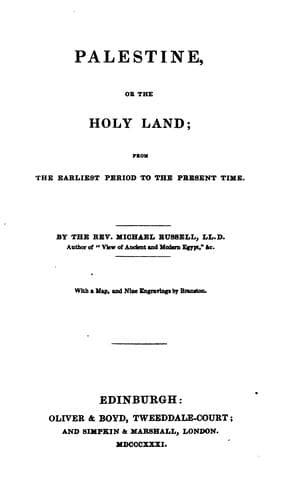
Palestine, or, the Holy Land: From the Earliest Period to the Present TimeRussell, Michael
History
Palestine, or, the Holy Land: From the Earliest Period to the Present Time
Russell, Michael
Palestine -- Description and travel; Palestine -- History
The conditions being ratified by the Egyptian sovereign, the Earl of
Cornwall had the satisfaction to see the great object of the Crusaders
once more accomplished. Palestine again belonged to the Christians. The
Hospitallers opened their treasury to rebuild the walls of Jerusalem,
while the patriarch and clergy entered the holy city to reconsecrate the
churches. For two years the gospel was the only religion administered in
the sacred capital, and the faithful had begun to exult in the permanent
subjection of their rivals, when a new enemy arose, more formidable to
them than even the Saracens.
The victories of Zingis Khan had displaced several nations belonging to
the great Tartar family, and among others the Karismians, who continued
their retreat southward till they reached the confines of Egypt. The
sultan, who perhaps had repented the liberality of his terms to the
soldiers of Richard, advised the expatriated barbarians to take possession
of Palestine. He even sent one of his principal officers and a large body
of troops to serve as them guides; upon which, Barbacan, the Karismian
general, at the head of twenty thousand cavalry, advanced into the Holy
Land. The garrison of Jerusalem, being quite inadequate to its defence,
retired, and were followed by many of the inhabitants. The invaders
entered it without opposition, sparing neither life nor property, and
respecting nothing, whether sacred or profane. At length the Templars and
Hospitallers, forgetting their mutual animosities, united their bands to
rescue the country from the grasp of such savages. A battle took place,
which, after continuing two whole days, ended in the total defeat of the
Christians; the Grand Masters of St. John and of the Temple being among
the slain. Only thirty-three individuals of the latter order, and sixteen
of the former, with three Teutonic cavaliers, remained alive, and
succeeded in making their way to Acre, the last refuge of the vanquished
knights. The Karismians, with their Egyptian allies, after having razed
the fortifications of Ascalon and Tiberias, encamped on the seacoast, laid
waste the surrounding territory, and slew or carried into bondage every
Frank who fell into their hands. Nor was it till the year 1247 that the
Syrians and Mamlouks, insulted by this northern horde, attacked them near
Damascus, slew Barbacan their chief, and compelled the remainder to
retrace their steps to the borders of the Caspian Lake.
Public-domain text, read in full here on John Shaqi.
Reviews
Reviews
No reviews yet
Be the first to share your thoughts on this work.
Elsewhere in the archive
Join the Discussion
Join the discussion
Sign in to leave a comment or review.
Sign InorCreate an account