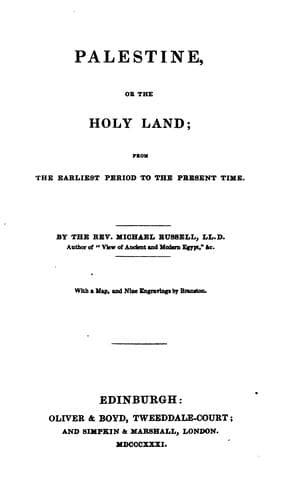
Palestine, or, the Holy Land: From the Earliest Period to the Present TimeRussell, Michael
History
Palestine, or, the Holy Land: From the Earliest Period to the Present Time
Russell, Michael
Palestine -- Description and travel; Palestine -- History
It has been remarked that the expedition of St. Louis into Egypt resembles
in many respects the war carried on in that country thirty years before.
In both cases the Christian armies were encamped near the entrance of the
Ashmoun canal, beyond which they could not advance; and the surrender of
Damietta in each instance was the price of safety. The errors of the
Cardinal Pelagius seem not to have been recollected by the French king,
who, in fact, trod in his steps with a fatal blindness, and ended by
paying a still severer penalty.
A gleam of hope arose in the minds of the Crusaders from finding the
rulers of Egypt and of Syria engaged in a furious war. The Mamlouks even
condescended to solicit the cooperation of Louis, and agreed to purchase
it by remitting one-half of the ransom which still remained unpaid. They
further consented to deliver up Jerusalem itself, and also the youthful
captives taken on the banks of the Nile, whom they had compelled to
embrace the Mussulman faith. But before the Franks could appear in the
field, the interposition of the calif had restored peace to the contending
parties, both of whom immediately resumed their wonted dislike to the
European invaders.
The infidels, however, at this period did not pursue their schemes of
conquest with the vigour and ability which distinguished the movements of
Noureddin, and more especially of Saladin, his renowned successor. They
might have swept the feeble and exhausted Christians from the shores of
Palestine; but they merely ravaged the country round Acre, and then
proceeded to Sidon, in the strong castle of which Louis and his army had
taken refuge. The blood and property of the citizens satisfied the
barbarians, who departed without trying the valour of the soldiers who
occupied the garrison.
The death of Queen Blanche, the mother of the king, and regent during his
absence, afforded him a good apology for leaving the country, of which he
had long been tired. The patriarch and barons of the Holy Land offered him
their humble thanks for the honour he had bestowed upon their cause, and
for the benefits which he had conferred upon themselves individually.
Louis, sensible that he had gathered no laurels in Palestine, and that the
interests of the church were even in a more hopeless condition than when
he landed at Damietta, listened to their address with mingled emotions of
shame and regret, and forthwith prepared himself for his voyage
homewards.[176]
Public-domain text, read in full here on John Shaqi.
Reviews
Reviews
No reviews yet
Be the first to share your thoughts on this work.
Elsewhere in the archive
Join the Discussion
Join the discussion
Sign in to leave a comment or review.
Sign InorCreate an account